Category: Emotional Healing

  • Softness is a Strength: Why You Don’t Have to Get Harder to Be Taken Seriously

    Softness is a Strength: Why You Don’t Have to Get Harder to Be Taken Seriously

    I used to believe that strength had to look like sharp edges. Like staying unbothered, never crying, walking through the world untouched, unaffected, and completely self-sufficient. I thought softness was a liability—something that would make people question my authority or overlook my worth.

    But here’s the truth no one told me: Softness is not the opposite of strength. It’s the birthplace of it.

    Softness is what lets you feel. Stay grounded. Stay human. It’s what allows you to stay connected to your intuition in a world that profits off your disconnection. It’s what keeps you tender in moments when life tries to turn you cold.

    I learned this the hard way. When I started showing up softer—more present, more in tune, more vulnerable—some people did fall away. But the right ones? The ones who could hold my full humanity? They leaned in. They saw me more clearly.

    We’re taught to lead like men to be respected. To speak with edge. To hustle harder. To earn our rest. But the women I admire most don’t lead with force—they lead with presence. With inner steadiness. With grace that refuses to shrink, even when it’s misunderstood.

    Here’s why you don’t have to harden to be taken seriously:

    Because power rooted in love is louder than power rooted in fear.

    Because boundaries set with clarity carry more weight than defenses built from trauma.

    Because when you trust your own voice, you don’t need to mimic anyone else’s tone.

    Because emotional regulation isn’t weakness—it’s wisdom.

    And here’s what softness can actually look like:

    Saying no without needing to explain yourself.

    Letting yourself cry when your heart is heavy—without shame.

    Speaking from your center, not from your armor.

    Choosing peace over performance.

    Walking away from spaces that only value you when you’re performing strength.

    Softness doesn’t mean shrinking. It doesn’t mean passivity. And it definitely doesn’t mean weakness.

    It means standing in your power while still choosing tenderness.

    It means protecting your peace without becoming hard to love.

    It means honoring your emotions as sacred messengers—not things to silence.

    This is your reminder:

    You don’t have to become harder to be respected.

    You just have to become more you.

    Let softness be your rebellion.

    Let it be the new standard for strength.

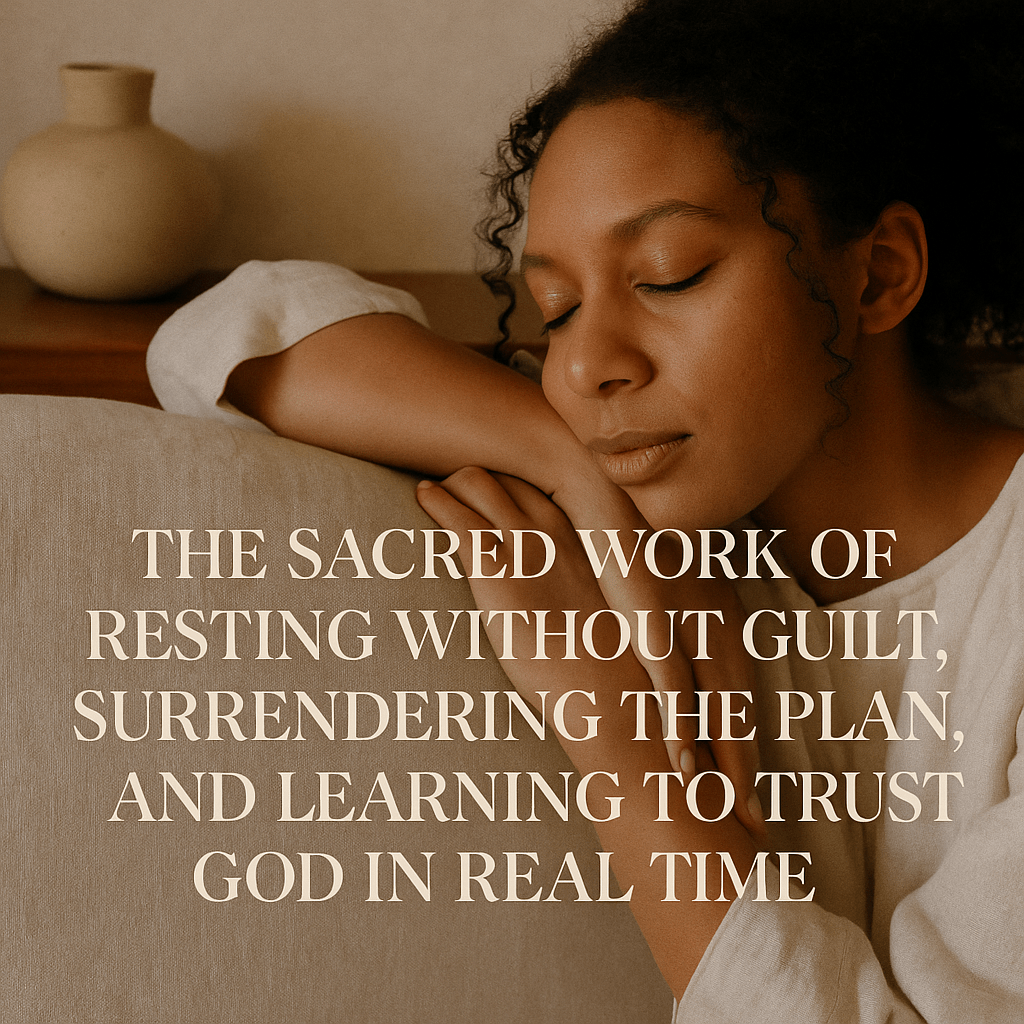
  • The Sacred Work of Resting Without Guilt, Surrendering the Plan, and Learning to Trust God in Real Time

    The Sacred Work of Resting Without Guilt, Surrendering the Plan, and Learning to Trust God in Real Time

    There was a moment—recently, actually—when I sat in my room surrounded by half-finished ideas, unopened emails, and a heart that felt too tired to keep performing.

    I looked around and realized…

    I had no plan. No next step. No fire left to fake it.

    And for the first time in a long time, I didn’t want to push through it.

    I just wanted to rest.

    But that scared me.

    Because rest, for women like us—women who have survived off strength—can feel like failure.

    Like letting the world move without you.

    Like being lazy. Or falling behind.

    But what if I told you that rest isn’t weakness?

    That surrender doesn’t mean defeat—

    It means devotion.

    It means trust.

    Nobody teaches you how to trust God in real time.

    Not when everything’s going right.

    I mean when the plan falls apart.

    When the vision board starts to feel like a lie.

    When you’re in the hallway between what you prayed for and what hasn’t shown up yet.

    It’s one thing to trust God with hindsight.

    But to trust Him right here—in the pause, in the unraveling, in the silence?

    That’s sacred work.

    Resting without guilt requires reparenting yourself.

    I had to sit with the part of me that only felt valuable when I was producing something.

    The part that confused hustle for healing.

    The part that believed if I wasn’t pushing, striving, creating—I wasn’t enough.

    That voice? It wasn’t mine.

    It was inherited.

    It was survival.

    It was my old blueprint.

    But I’m building a new one now.

    One where rest is not earned—it’s honored.

    One where I don’t need a reason to pause.

    One where I can lay my plans down without thinking I’m letting God down too.

    This season has taught me something I’ll never forget:

    When you stop trying to control every outcome,

    When you stop begging for clarity before you take a step,

    When you stop asking “God, just give me the full picture” before you move…

    You finally start to live from trust instead of fear.

    Not because you know what’s coming.

    But because you know Who is with you in the unknown.

    Here’s how I’m learning to rest, surrender, and trust right now:

    1. I no longer ask for signs. I ask for stillness.

    Because sometimes the sign is in the pause.

    Sometimes God is saying, “You don’t need confirmation. You just need to breathe.”

    2. I give myself permission to not be “on.”

    Not every season is meant for output.

    Some seasons are meant to restore what burnout tried to steal.

    3. I lay the plan down every morning.

    Literally. I write my to-do list and then I whisper:

    “But God, if You need to interrupt this—I trust You.”

    That’s not easy. But it’s freedom.

    4. I remember that provision is not limited by my performance.

    Even when I rest, He works.

    Even when I pause, I’m still held.

    Even when I don’t feel productive, I am still protected.

    So if you’re tired—really tired—this post is your permission slip.

    To stop forcing.

    To stop pretending.

    To stop proving.

    Lay it all down.

    The timeline.

    The expectation.

    The weight.

    And pick up something lighter:

    Peace.

    Presence.

    God’s promise.

    You don’t need to have it all figured out.

    You just need to trust that you’re not being forgotten in the stillness.

    This is sacred.

    This is holy.

    This… is real-time trust.

    And if all you can do today is breathe, whisper a prayer, and believe that rest is also part of the work—

    then baby, you are right on time.

  • How to Let Go Without Shaming Who You Were

    How to Let Go Without Shaming Who You Were

    Let’s be real.

    There are parts of us we don’t always like to revisit.

    Versions of ourselves that feel… messy.

    The one who settled. The one who stayed too long. The one who didn’t know her worth yet.

    And sometimes, when we’re trying to evolve, it’s easy to look back on her and cringe.

    But here’s the truth most people won’t say:

    You can’t fully become who you’re meant to be if you’re still shaming who you used to be.

    That version of you?

    She was surviving with what she knew.

    She was loving with what she had.

    She was doing her best, even when it wasn’t perfect.

    This isn’t about bypassing accountability. It’s about holding your past self with compassion instead of a gavel.

    Because we love to post about healing.

    We love to talk about “leveling up.”

    But sometimes, healing looks like visiting the girl you used to be—not to judge her, but to thank her.

    Because without her choices, her mistakes, her heartbreaks… you wouldn’t be here.

    She may have been lost, but she was still leading you home.

    I used to shame the parts of me that let things slide.

    That overextended. That kept trying to prove I was worth loving.

    But the more I tried to erase her, the more stuck I felt.

    I realized that real growth isn’t just about letting go.

    It’s about letting go with love.

    That means:

    Not deleting her, but integrating her.

    Not rolling your eyes at her, but thanking her for her lessons.

    Not hiding her, but understanding her needs

    So how do you let go without the shame?

    1. Change the story.

    Instead of: “I can’t believe I let that happen.”

    Try: “That version of me didn’t know what I know now—and that’s okay.”

    2. Write her a letter.

    Not a letter of blame, but of closure.

    Tell her what you’ve learned. Tell her what you’re proud of her for.

    Tell her she can rest now.

    3. Speak to her gently.

    When that old pattern shows up, don’t yell at it.

    Whisper: I see you. I know what you’re trying to protect me from. But we’re safe now.

    4. Don’t rush the release.

    Letting go isn’t a one-time act—it’s a practice.

    Every time you choose differently, you’re releasing her a little more.

    5. Mirror her with love.

    Stand in front of your reflection and say:

    I forgive you. I love you. I honor what you were trying to do for me.

    You don’t have to hate who you were to become who you’re meant to be.

    You just have to let her be human.

    You just have to soften the edges around the memories.

    You just have to hold her long enough to say: Thank you… but I’m ready now.

    This is how you move on—with grace, not guilt.

    This is how you release the weight without rejecting your roots.

    This is how you heal with softness, not shame.

    You don’t need to punish your past to claim your future.

    You just need to let go… gently.

  • Reclaiming Your Radiance: How to Return to Yourself After Emotional Burnout

    Reclaiming Your Radiance: How to Return to Yourself After Emotional Burnout

    There was a season in my life where I didn’t recognize myself in the mirror. Not in the poetic, I’ve-evolved kind of way. I mean I literally couldn’t find the light in my eyes. I was showing up for everyone—my kids, my job, my relationship, the expectations—and somehow, I forgot how to show up for me.

    Some mornings, I would wake up and stare at the ceiling, knowing I had things to do… but feeling like I was underwater. I knew how to function, but I didn’t know how to feel. I’d smile at people and check off tasks, but inside, I felt numb. Drained. Hollow. Burnt out in ways that no amount of sleep or self-care Sundays could fix.

    This wasn’t laziness. It wasn’t weakness. It was emotional burnout. And it was eating away at my radiance.

    What Burnout Really Steals From You

    Burnout doesn’t just drain your energy—it steals your sense of self.

    You stop laughing like you used to. You stop dancing in the kitchen. You forget what it’s like to be soft because you’ve had to be so strong. You start settling—not because you want less, but because you’re too tired to fight for more.

    And no one really talks about how lonely that place is.

    Because you don’t look “broken.” You’re functioning. You’re surviving.

    But inside, you feel like a stranger to yourself.

    The Moment I Knew I Had to Come Home to Myself

    There was a night—I remember it vividly—I sat in the parking lot of a gas station crying into the steering wheel. I had just left a conversation where I made myself small again. I kept my peace at the cost of my truth. And I thought… when did I become okay with that?

    I wasn’t okay. I just didn’t know how to stop pretending.

    That night, I whispered out loud: “I want to come back to me.”

    And I meant it.

    The Feminine Way Back: Not a Hustle, But a Return

    Reclaiming your radiance doesn’t come from doing more—it comes from being more honest.

    You don’t have to light a hundred candles, meditate for 45 minutes, or book a solo trip to Bali to find yourself again. Sometimes, coming home to yourself looks like:

    • Saying no without overexplaining.

    • Wearing something soft and beautiful just because it makes you feel like you.

    • Turning off your phone for an hour and letting your body rest.

    • Letting yourself cry without needing a reason.

    • Laughing—really laughing—at something ridiculous.

    • Admitting that you’ve been hurting.

    • Letting someone show up for you for once.

    Soft Power Isn’t Loud—It’s Liberating

    They told us we had to be strong. That we had to push through. That softness was weakness.

    But I’m learning that there is nothing more powerful than a woman who reclaims her softness after being hardened by life. Nothing more radiant than a woman who glows again after going dim. Nothing more magnetic than a woman who’s not trying to prove anything—but has returned to her truth.

    And the truth is: your radiance was never gone.

    It was just buried beneath the burnout.

    You’re still in there. And you’re worth coming back to.

    A Soft Invitation to You

    If you’re reading this and it feels familiar—if you’re tired of being tired, tired of being everything for everyone but nothing for yourself—I want you to ask yourself gently:

    What would it look like for me to come home to myself this week?

    Not all at once. Not perfectly.

    Just one tiny moment where you choose you again.

    Because the world needs your light.

    But more than that, you need your light.

    And it’s never too late to turn it back on.

  • The Power of Letting Go: Releasing What No Longer Serves You

    The Power of Letting Go: Releasing What No Longer Serves You

    Sometimes, the hardest thing we can do for ourselves is let go. We hold on to people, situations, and beliefs that no longer serve us, believing that holding on means we’re strong. But the truth is, the real power comes from the courage to release—to let go of what’s hurting us, what’s keeping us stuck, and what’s no longer aligned with the woman we’re becoming. Letting go isn’t weakness; it’s a radical act of self-love, one that allows you to release the chains that hold you back and make space for the abundance and joy meant for you.

    Why Letting Go is Essential for Growth:

    Growth is a messy, imperfect journey. It can feel like a battle we’re not prepared for, and sometimes we’re scared to face it. But here’s the truth I wish I’d known sooner: letting go is part of your growth story. Without it, you can’t fully evolve into the version of yourself that is free and capable of reaching your full potential.

    I remember countless nights lying awake, worried about what would happen if I finally let go. Would I lose myself? Would I have the courage to rebuild? Would I be forever alone? These fears held me captive for so long. I didn’t realize at the time that those fears were just illusions. What I discovered later is that letting go wasn’t the end—it was the beginning of something much more beautiful.

    When I allowed myself to release what no longer served me, I felt lighter. It was as if I could breathe again. Although the process wasn’t easy, it was empowering. Letting go became my ticket to reclaiming myself, my peace, and stepping into my own power. It’s a journey I wish I had embraced sooner.

    What to Let Go Of:

    1. Toxic Relationships:

    • One of the hardest things to do is to walk away from relationships that drain us. I held on for years, believing that loyalty meant staying—even when it was toxic. But staying in relationships that made me feel small or unappreciated only led me further away from my true self. Letting go of these relationships was one of the most challenging, but necessary steps I’ve taken to preserve my peace. It wasn’t just about walking away from others, but walking towards a life that honored who I am.

    2. Old Beliefs About Yourself:

    • How often do we hold on to limiting beliefs that keep us small? For years, I thought I wasn’t worthy of success, love, or true happiness. These false beliefs weighed me down and kept me from living the life I wanted. But the day I asked myself, “Why am I choosing to stay small?” everything shifted. I started to see my worth, my power, and my beauty in ways I hadn’t before. Letting go of those beliefs wasn’t immediate, but it was life-changing.

    3. Past Mistakes and Guilt:

    • I spent so much time living in regret. I couldn’t forgive myself for mistakes I’d made, things I couldn’t undo. But as I started to forgive myself, I realized that holding on to guilt was preventing me from moving forward. Letting go of regret has been a long journey, but it has brought me closer to peace, acceptance, and freedom.

    The Freedom You Gain from Letting Go:

    When we let go, we create space. Space for new opportunities, for healing, and for love. Letting go has given me freedom in so many ways—freedom from regret, freedom from the past, and the freedom to live in alignment with the woman I’m becoming. It has allowed me to step into my power, to trust in my own worth, and to finally believe that I deserve the life I’ve always dreamed of.

    How to Let Go:

    1. Acknowledge What Needs to Go:

    • The first step in letting go is recognizing what no longer serves you. Whether it’s a toxic relationship, an outdated belief, or a past mistake, acknowledging what needs to be released is crucial. Be honest with yourself and give yourself permission to let go.

    2. Let Yourself Feel:

    • Letting go isn’t just about rationalizing that something doesn’t serve you. It’s about feeling the emotions that come with it—anger, sadness, fear. Allow yourself to grieve. Give yourself permission to feel the sadness, anger, or fear. Feel it all so you can release it.

    3. Take Empowered Action:

    • After processing the emotions, take action. Whether it’s setting boundaries, speaking your truth, or forgiving yourself, every step you take toward letting go is an affirmation of your self-worth. You deserve a life filled with joy, love, and peace.

    The Importance of Managing Our Reactions:

    Here’s something that’s so crucial: we are not responsible for others’ emotions, bad behavior, or emotional baggage. We can’t control how others feel or act. What we are responsible for is how we choose to manage our stress, how we react to discomfort, disappointment, and stress.

    We often internalize other people’s emotional reactions, thinking we need to fix things, apologize, or take on their pain. But the truth is, we are only responsible for our own emotional landscape. We can choose how we react to stress, setbacks, or other people’s negative behaviors. We are not obligated to carry anyone else’s burdens but our own.

    By letting go of the weight of others’ emotions and focusing on how we manage ourselves in stressful situations, we free ourselves to respond with grace, clarity, and strength. We no longer need to take on the emotional burdens that are not ours to bear.

    Call to Action:

    I challenge you today to reflect on what you are holding onto. Is it a relationship, a belief, or a past mistake that’s keeping you stuck? Think about what you can release today, and make the conscious decision to let it go. When you do, you’ll create the space for all the amazing things that are meant for you.

    Letting go is not a sign of weakness; it’s an act of love, strength, and self-respect. It’s about releasing what no longer serves you and making room for something better. Remember, you are not responsible for others’ emotions, bad behavior, or emotional baggage. You are only responsible for how you manage your own emotions and reactions. When you choose to let go, you step into a future where you can shine as the fullest, most powerful version of yourself.

    Letting go isn’t just about the things you release—it’s about the life you make space for. You deserve freedom, peace, and joy. It’s time to let go of what no longer serves you and step into your full potential.

    A Personal Message:

    I want you to know that I see you. I hear you. I value you. This journey of letting go is not easy, and I honor the courage it takes to do so. Please remember, you are not alone in this process. We are all on this path together, learning and growing. And as you navigate the pain and release, always remember that you are worthy of everything good and beautiful that is waiting for you.

    You’ve got this. I believe in you.

    This post should be emotionally impactful, empowering, and offer actionable advice for your readers. The emphasis with italics and bold will highlight key parts of the message and make it more engaging.