Category: Emotional Wellness

  • Wholeness Doesn’t Mean You’re Always Okay: Holding Space for the Messy Middle

    Wholeness Doesn’t Mean You’re Always Okay: Holding Space for the Messy Middle

    There’s this quiet pressure in healing culture that whispers, “If you’re doing the work, you shouldn’t still feel like this.”

    But real healing—soul-deep, identity-shifting, root-pulling healing—is not linear, polished, or predictable.

    Wholeness does not mean you’re always okay.

    It means you’re always becoming.

    Some days you’ll feel like the woman you prayed to become. Other days, you’ll feel like the girl who needed rescuing. And both can exist within you. At the same time. Without contradiction. Without shame.

    The Lie of Constant Progress

    We’re taught to measure growth by progress. By movement. By proof. But some of the deepest healing happens in stillness—in the unseen choices, in the quiet no’s, in the tears you don’t post, in the days you show up without makeup or a plan, and still breathe through it.

    There is no perfect version of you waiting at the end of the path. You’re not a problem to be solved. You are a process unfolding.

    This Is What the Messy Middle Looks Like:

    You set boundaries, then second-guess them.

    You choose softness, then feel exposed.

    You reclaim your worth, then catch yourself trying to earn it.

    You feel proud and still deeply tired.

    This is not a setback. It’s the space in between—where you grieve, recalibrate, and re-learn what safety feels like in your body.

    Holding Space for All of You

    You are not meant to heal in a straight line. You are allowed to pause. To feel joy and grief within the same breath. To still long for clarity while honoring how far you’ve come. To admit that even as a whole woman, sometimes you’re just… tired.

    Stop waiting until you feel “more together” to show up for your life. You are already whole. Even when you wobble. Even when you cry. Even when you can’t explain why you feel the way you do.

    This is the brave part of healing no one talks about: allowing the mess and the magic to sit beside each other.

    Let that be enough today.

    If this resonated with you, take a moment to explore more essays inside The Soft Power Journal. Each piece is a quiet return to truth, softness, and soul.

  • The Mirror Isn’t Lying—You Just Forgot Who You Were

    The Mirror Isn’t Lying—You Just Forgot Who You Were

    The other day, I looked in the mirror and froze.

    Not because I didn’t like what I saw—

    but because I didn’t recognize her.

    The eyes were familiar. The skin was soft. The expression was calm.

    But something about her felt… distant. Muted. Unnamed.

    And then it hit me:

    I’ve been so busy surviving, evolving, adapting, performing… I forgot how to just be.

    I forgot who I was underneath the layers.

    But the mirror?

    She wasn’t lying.

    She was simply reflecting the truth I’d been avoiding:

    I lost touch with the version of me I never should’ve left behind.

    We don’t just lose ourselves in crisis.

    We lose ourselves in expectations.

    In performance.

    In being what everyone else needed before we ever asked ourselves what we needed.

    We disappear behind the “good girl.”

    The reliable friend. The strong one. The healer. The doer. The one who doesn’t need anything.

    Until one day, we stop asking what we want altogether.

    We’re just… functioning.

    Smiling on cue. Showing up out of habit.

    But disconnected from our joy, our depth, our essence.

    You don’t need to reinvent yourself. You need to return to yourself.

    Because she’s still in there.

    The girl who loved loudly.

    Who didn’t apologize for her softness.

    Who danced without needing a reason.

    Who believed her voice mattered before the world tried to silence her.

    You didn’t lose her.

    You just stopped listening.

    But the mirror? She remembers.

    And she’s waiting for you to remember, too.

    Here’s how I started returning to the version of me I forgot:

    1. I made a “Remember Me” list.

    I wrote down what I used to love, before I tried to make everyone else comfortable.

    Books I devoured. Music I cried to. The way I dressed when I wasn’t dressing for approval.

    It brought her back to me.

    2. I stood in the mirror and said, “I miss you.”

    I let the grief surface.

    Because sometimes remembering who you were means mourning who you had to become just to survive.

    3. I stopped waiting to feel ready to be her again.

    You don’t have to “go back.”

    You just have to say yes to who you’ve always been.

    Even if it’s one gentle layer at a time.

    The mirror isn’t here to expose you. It’s here to bring you home.

    So let yourself come back.

    To the softness.

    To the laughter.

    To the clarity.

    To the girl who still lives under the ache.

    She didn’t leave.

    She’s just been waiting for you to stop performing and start remembering.

    You are not lost. You are layered.

    And every layer you peel back brings you closer to the girl who never stopped whispering:

    I’m still in here.

  • The Truth Is, I Wasn’t Lazy—My Nervous System Was Tired

    The Truth Is, I Wasn’t Lazy—My Nervous System Was Tired

    For the longest time, I thought I was the problem.

    The version of me who couldn’t get out of bed some days.

    The one who started a project and abandoned it halfway through.

    The woman who kept telling herself, “You have so much potential, why can’t you just do the thing?

    I wasn’t lazy.

    I was tired.

    But not just physically tired—my nervous system was tired.

    And I didn’t know how to name that until I started healing for real.

    Nobody talks about what happens after survival mode ends.

    When your body finally has permission to pause.

    When the adrenaline fades.

    When the constant urgency quiets—

    And suddenly, you don’t know how to function without chaos driving the wheel.

    That’s not laziness.

    That’s your nervous system asking: “Can I finally rest now?

    I’ve learned that “not doing enough” is often just your body trying to protect you.

    And for women who have carried generations of pressure, perfectionism, and productivity—we don’t always know how to just be.

    We shame our slowness.

    We label our fatigue as failure.

    We call ourselves lazy when really…

    we’re just trying to feel safe for the first time.

    Here’s what nervous system exhaustion can look like (that you might mistake for laziness):

    Chronic procrastination (your brain is overloaded, not unmotivated)

    Forgetfulness or zoning out (that’s dissociation, not flakiness)

    Starting something, then freezing (a trauma response, not inconsistency)

    Struggling to complete simple tasks (because your energy is in survival, not thriving)

    Feeling “numb” when you used to be excited (that’s emotional depletion, not apathy)

    So how do we start honoring our nervous systems instead of shaming them?

    1. Replace judgment with curiosity.

    Instead of “What’s wrong with me?” try:

    What might my body be trying to say?

    2. Make rest part of the healing—not the reward.

    You don’t have to earn it. You need it.

    Daily. Not just after burnout.

    3. Start with micro moves.

    When you feel frozen, try the 2-minute rule.

    Two minutes of movement.

    Two minutes of breath.

    Two minutes of showing up for yourself—gently.

    4. Learn your own regulation tools.

    For some, that’s walking.

    For others, journaling. Or humming. Or crying. Or breathwork.

    Your body has wisdom. Let her lead.

    This is your reminder: You are not broken. You’re just healing.

    Healing is a full-body thing.

    It affects your energy. Your emotions. Your motivation.

    And yes, your capacity.

    You’re not behind.

    You’re not lazy.

    You’re learning how to feel safe again—without chaos, without pressure, without constantly proving your worth.

    So next time your body asks to slow down…

    Don’t call it lazy.

    Call it sacred.

    Call it nervous system wisdom.

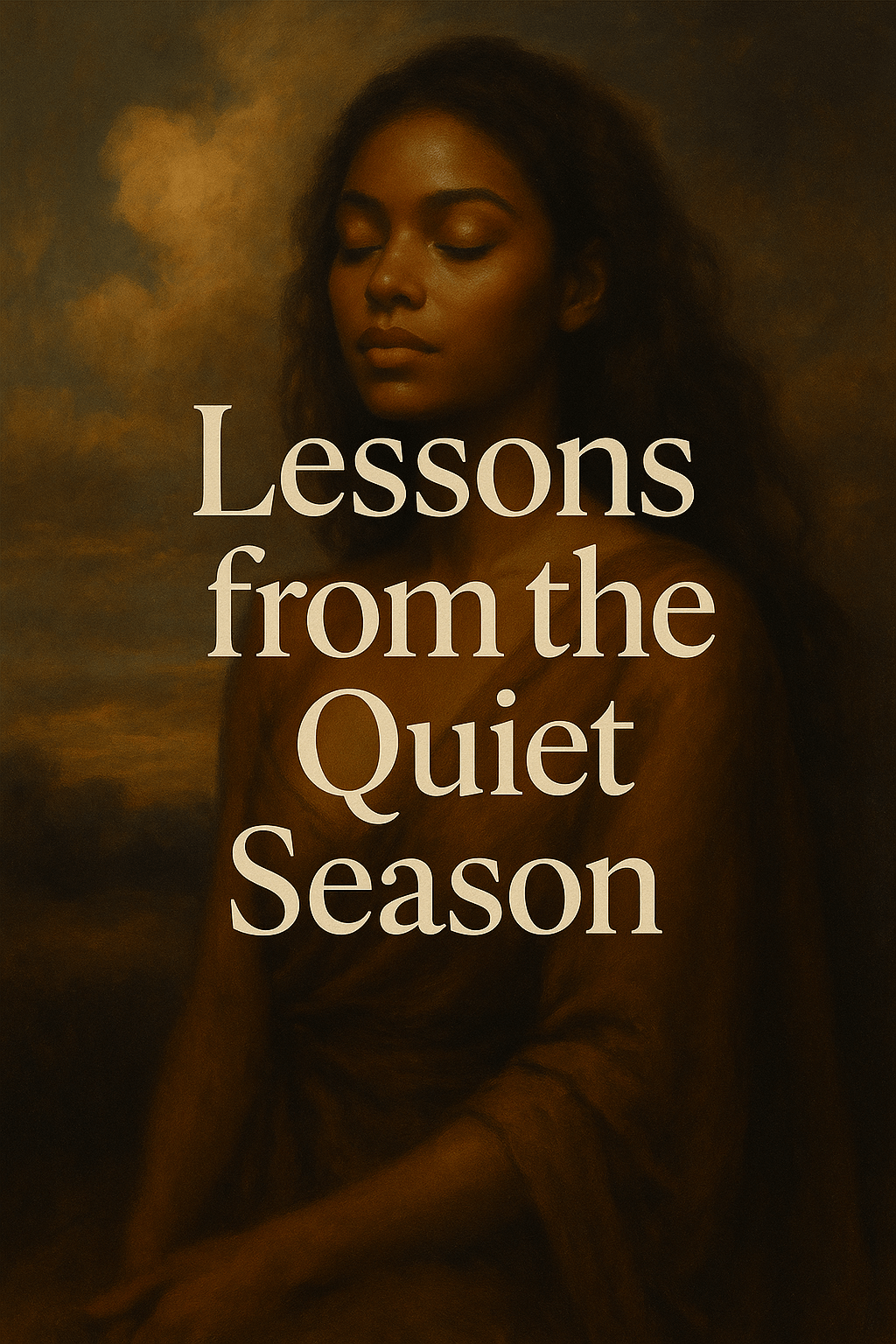
  • Lessons from the Quiet Season

    Lessons from the Quiet Season

    No one really prepares you for the season when life goes quiet.

    You’re not spiraling, but you’re not soaring.

    You’re not broken, but you’re not blooming either.

    You’re just… here.

    In the space between what was and what’s coming.

    In the silence between prayers and answers.

    And at first, it’s peaceful.

    But then it gets uncomfortable.

    You start asking yourself: Am I missing something? Did I mess this up? Why isn’t anything happening?

    But I want you to know something:

    The quiet season isn’t a punishment. It’s a classroom.

    I’ve been in that season.

    When the plans stall. When the friends disappear.

    When the spark fades and the noise dims and you don’t know what to grab onto.

    And I remember thinking: God, did You forget about me?

    But He didn’t.

    He was just speaking in a language I hadn’t learned yet:

    stillness.

    Because in the quiet, everything echoes louder—your doubts, your desires, your truth.

    And if you listen closely, you’ll realize:

    The quiet doesn’t mean nothing’s happening. It means something sacred is.

    Here’s what the quiet season teaches you—if you let it:

    1. Who are you when no one’s clapping?

    When no one’s validating you. When there’s no audience, no applause, no obvious results.

    Can you still show up for yourself?

    2. Can you hear your own voice beneath the noise?

    The quiet strips away distractions.

    It asks you to tune back into you—your needs, your values, your spirit.

    3. Not everything that slows you down is a setback.

    Sometimes, it’s divine pacing.

    Sometimes, it’s protection disguised as a pause.

    So if you’re in the quiet season right now, try this:

    Create a “Stillness Practice.”

    Each morning or night, ask yourself: What do I need to hear today?

    Write down whatever comes up. It doesn’t have to make sense. Let your spirit speak.

    Start noticing what’s growing instead of what’s missing.

    Maybe your patience.

    Maybe your trust.

    Maybe your emotional capacity.

    Reframe the silence.

    Instead of “Nothing is happening,” try: “I’m being refined in ways I can’t see yet.

    There is something beautiful being built inside the silence.

    This season is not wasted.

    This season is not void.

    It is an altar. It is a cocoon.

    It is the quiet before your bloom.

    So breathe.

    Take the pressure off.

    And remember:

    Sometimes the most powerful things grow in silence first.