Category: Healing & Growth

  • The Truth Is, I Wasn’t Lazy—My Nervous System Was Tired

    The Truth Is, I Wasn’t Lazy—My Nervous System Was Tired

    For the longest time, I thought I was the problem.

    The version of me who couldn’t get out of bed some days.

    The one who started a project and abandoned it halfway through.

    The woman who kept telling herself, “You have so much potential, why can’t you just do the thing?

    I wasn’t lazy.

    I was tired.

    But not just physically tired—my nervous system was tired.

    And I didn’t know how to name that until I started healing for real.

    Nobody talks about what happens after survival mode ends.

    When your body finally has permission to pause.

    When the adrenaline fades.

    When the constant urgency quiets—

    And suddenly, you don’t know how to function without chaos driving the wheel.

    That’s not laziness.

    That’s your nervous system asking: “Can I finally rest now?

    I’ve learned that “not doing enough” is often just your body trying to protect you.

    And for women who have carried generations of pressure, perfectionism, and productivity—we don’t always know how to just be.

    We shame our slowness.

    We label our fatigue as failure.

    We call ourselves lazy when really…

    we’re just trying to feel safe for the first time.

    Here’s what nervous system exhaustion can look like (that you might mistake for laziness):

    Chronic procrastination (your brain is overloaded, not unmotivated)

    Forgetfulness or zoning out (that’s dissociation, not flakiness)

    Starting something, then freezing (a trauma response, not inconsistency)

    Struggling to complete simple tasks (because your energy is in survival, not thriving)

    Feeling “numb” when you used to be excited (that’s emotional depletion, not apathy)

    So how do we start honoring our nervous systems instead of shaming them?

    1. Replace judgment with curiosity.

    Instead of “What’s wrong with me?” try:

    What might my body be trying to say?

    2. Make rest part of the healing—not the reward.

    You don’t have to earn it. You need it.

    Daily. Not just after burnout.

    3. Start with micro moves.

    When you feel frozen, try the 2-minute rule.

    Two minutes of movement.

    Two minutes of breath.

    Two minutes of showing up for yourself—gently.

    4. Learn your own regulation tools.

    For some, that’s walking.

    For others, journaling. Or humming. Or crying. Or breathwork.

    Your body has wisdom. Let her lead.

    This is your reminder: You are not broken. You’re just healing.

    Healing is a full-body thing.

    It affects your energy. Your emotions. Your motivation.

    And yes, your capacity.

    You’re not behind.

    You’re not lazy.

    You’re learning how to feel safe again—without chaos, without pressure, without constantly proving your worth.

    So next time your body asks to slow down…

    Don’t call it lazy.

    Call it sacred.

    Call it nervous system wisdom.
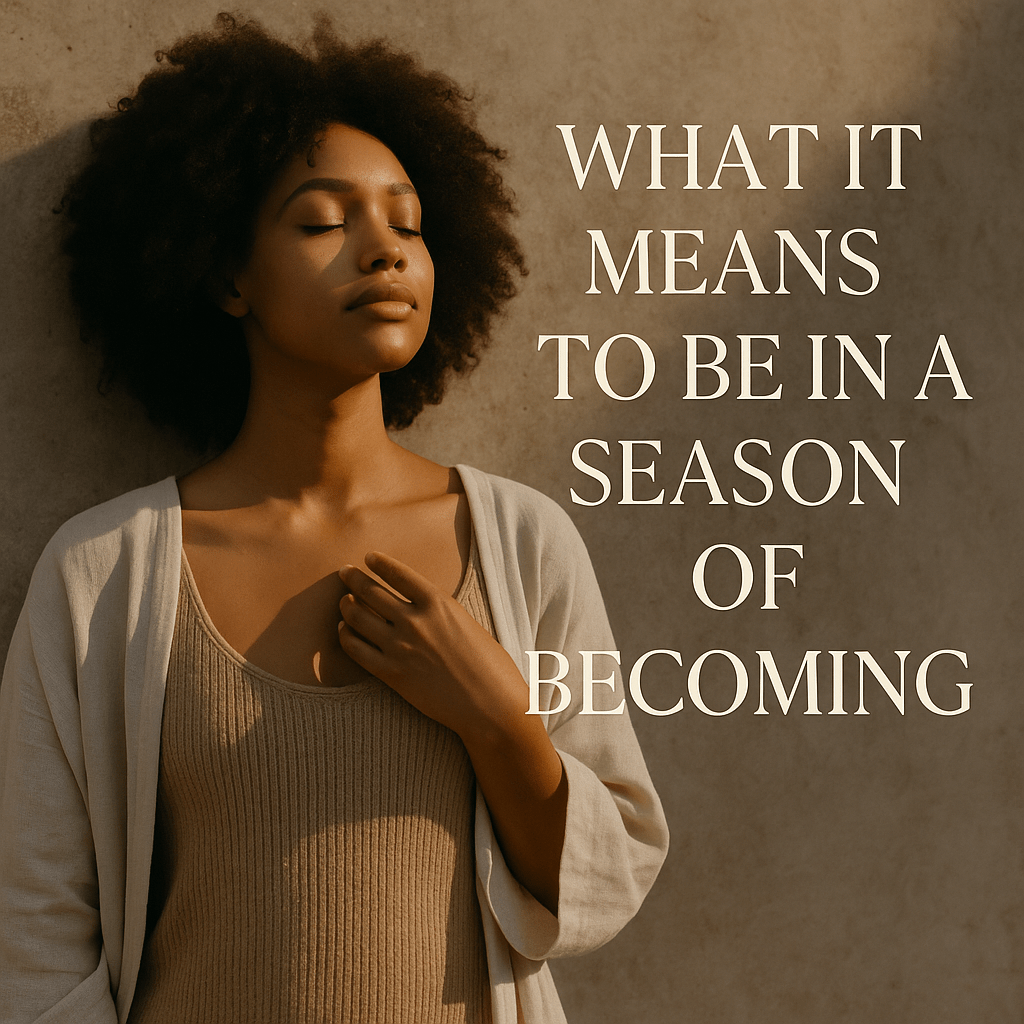
  • What It Means to Be in a Season of Becoming

    What It Means to Be in a Season of Becoming

    Becoming isn’t always beautiful.

    It’s not always soft music and sunrise journaling.

    Sometimes it’s crying in the shower, questioning everything, feeling like you’re floating between two worlds—no longer who you were, not yet who you’re becoming.

    But that’s exactly what this is:

    The season of becoming.

    The sacred in-between.

    No map. No clear answers.

    Just you. And God. And the whisper that says:

    Keep going. Something is unfolding, even if you can’t name it yet.

    Becoming is the undoing.

    It’s shedding layers that used to protect you.

    It’s releasing identities you outgrew but held onto out of comfort.

    It’s grieving old versions of yourself while still unsure of the new ones.

    And it’s hard.

    It’s confusing.

    It’s holy.

    Because becoming isn’t about achievement. It’s about alignment.

    Here’s what being in a season of becoming really looks like:

    You start feeling misaligned in spaces you used to tolerate.

    You stop rushing to fix things and start sitting with what is.

    Your prayers shift from “Give me clarity” to “Help me trust the unknown.”

    You release timelines. You question roles.

    You soften your grip.

    It’s a season where the outcomes don’t make sense yet—

    but the inner shifts are undeniable.

    It’s a season where the outcomes don’t make sense yet—

    but the inner shifts are undeniable.

    If you’re here right now, try this:

    1. Honor the unraveling.

    Instead of asking “What’s wrong with me?” try:

    “What part of me is evolving?”

    2. Write a letter titled “I Don’t Have to Know Yet.”

    Let yourself express all the uncertainty without needing a solution.

    This is about voice, not fixing.

    3. Create a Becoming Box.

    Fill it with items, quotes, and reminders that anchor you in this liminal space.

    A journal. A candle. A photo. Something that reminds you you’re still whole—even mid-transition.

    The season of becoming is not the pause between two real chapters.

    It is the chapter.

    It’s where the courage is built.

    It’s where the softness becomes strength.

    It’s where your roots deepen in the dark before you ever bloom in the light.

    So if you feel lost right now, just know:

    You’re not lost. You’re becoming.

    Let it be messy. Let it be unclear.

    Let it stretch you.

    Because the woman you’re becoming?

    She’s already unfolding.

    And she’s worth every ounce of grace you can give yourself in this sacred middle.