Category: Mindset & Self Worth

  • The Moment I Realized My Power

    The Moment I Realized My Power

    Because Strength Doesn’t Have to Be Loud

    I used to believe that strength meant being loud. That power meant proving myself, speaking up first, and making sure my presence was felt. I thought that to be strong, I had to be forceful. But there was a moment—a defining one—when I realized that true strength isn’t about how loudly you demand attention.

    It’s about how effortlessly you command it.

    The Moment That Changed Everything

    There was a time when I found myself in a situation where I would have normally reacted—pushed, spoken up, fought to be heard. Instead, I did something different. I leaned back. I stayed still. I allowed the situation to unfold without forcing it.

    And something unexpected happened—everything started working in my favor.

    I wasn’t weak for not reacting. I wasn’t losing control by not proving myself. I was owning my power by choosing stillness over force, grace over reaction, certainty over doubt.

    That was the moment I realized that soft power—quiet, deliberate, deeply-rooted strength—is far more magnetic than trying to prove anything to anyone.

    What Soft Power Truly Means

    Soft power isn’t about being passive. It isn’t about shrinking or letting things happen to you.

    It’s about understanding your worth so deeply that you don’t have to fight for space. It’s about knowing that your presence, energy, and confidence are enough.

    Here’s what I’ve learned:

    • Power isn’t about talking the loudest; it’s about saying the least and still being heard.

    • Confidence isn’t about forcing a response; it’s about knowing you don’t need one.

    • Strength isn’t about control; it’s about trust—trusting yourself, your energy, and the way life unfolds.

    How You Can Embrace Soft Power

    If you’ve ever felt like you had to prove yourself, fight for attention, or make your presence known, I want you to consider this:

    What would happen if you leaned back instead of chasing? If you allowed instead of forcing? If you trusted instead of controlling?

    Here’s how you can start embracing soft power today:

    1. Master the Art of Presence – You don’t need to take up space loudly. Your energy speaks before you even say a word.

    2. Respond, Don’t React – Power is in pausing, observing, and choosing your words carefully.

    3. Trust That What’s Meant for You Will Come – Soft power is deeply rooted in self-trust and divine timing.

    4. Speak Less, Mean More – When you do speak, let your words hold weight, depth, and certainty.

    5. Embody Confidence, Not Force – True confidence isn’t loud; it’s felt. It’s in how you carry yourself, not in how much you say.

    Soft Power Is the Ultimate Strength

    That moment when I chose stillness over reaction changed everything for me. I realized that I didn’t need to prove myself to be powerful—I just needed to embody my worth.

    If this resonates with you, I’d love to know:

    💬 Have you ever experienced a moment where you realized your soft power? Share your thoughts in the comments—I’d love to hear your story.

  • Surrendering the Plan: Learning to Trust God in Real Time

    Surrendering the Plan: Learning to Trust God in Real Time

    Let me be honest—

    I love a good plan. A five-step strategy. A mapped-out vision with bullet points and backup routes.

    I love knowing what’s coming.

    It makes me feel safe.

    But lately?

    God hasn’t been giving me a plan.

    He’s been giving me moments.

    Moments that stretch me, quiet me, reroute me, and ask me to trust without clarity.

    And trusting God in real time?

    It’s one of the hardest things I’ve ever had to learn.

    Real-time trust doesn’t come with a roadmap.

    It comes with a whisper: “Are you willing to move before it all makes sense?

    It comes with blank pages, canceled plans, and doors you thought were yours slamming shut.

    It comes with you looking around, asking:

    God, I thought I was ready. Why does this feel like falling apart instead of falling into place?

    But what I’m learning is this:

    Trust isn’t built when everything is going right. It’s built in the silence between what you prayed for and what hasn’t shown up yet.

    I had to learn that surrender doesn’t mean giving up—it means letting go of my way.

    Letting go of the fantasy timeline.

    Letting go of the need to control the outcome.

    Letting go of my obsession with being “prepared enough.”

    Because sometimes, God doesn’t want your preparation—He wants your presence.

    He wants your obedience in the uncertainty.

    He wants your yes even when you’re trembling.

    Here’s what learning to trust God in real time has looked like for me:

    Saying yes to opportunities I didn’t feel fully ready for

    Leaving spaces I prayed to enter, because I no longer belonged there

    Pausing projects that used to bring me life, because they were now draining me

    Listening more, striving less

    Being okay with not being “on fire” but still being faithful

    I’ve had to stop asking for a five-year vision and start asking for today’s instructions.

    If you’re in this space—where nothing looks clear but you know you’re being called to trust—try this:

    1. Start your day with surrender.

    Before the to-do list. Before the scroll.

    Say: “God, interrupt my plan if You need to. I trust You more than I trust my own control.

    2. Accept that clarity often comes in hindsight.

    Don’t wait for the whole staircase—just take the next step you do see.

    3. Stop needing to “feel ready.”

    Obedience won’t always feel comfortable.

    Move anyway. Speak anyway. Begin anyway.

    4. Pay attention to peace.

    God’s plan often sounds like stillness, not pressure.

    If the plan is stressing your soul, it might be time to let it go.

    You don’t need to figure everything out. You just need to stay open.

    Let this be your reminder:

    You’re not falling behind when the plan shifts—you’re being aligned in real time.

    What feels like delay might actually be divine protection.

    What feels like loss might actually be redirection.

    And what looks like confusion might actually be the start of your clearest season yet.

    If you’re learning to walk with God moment by moment,

    If you’re trying to surrender the plan without collapsing in fear,

    If you’re trusting without the full picture—

    You’re doing sacred work.

    You’re walking by faith.

    And that… is more than enough.

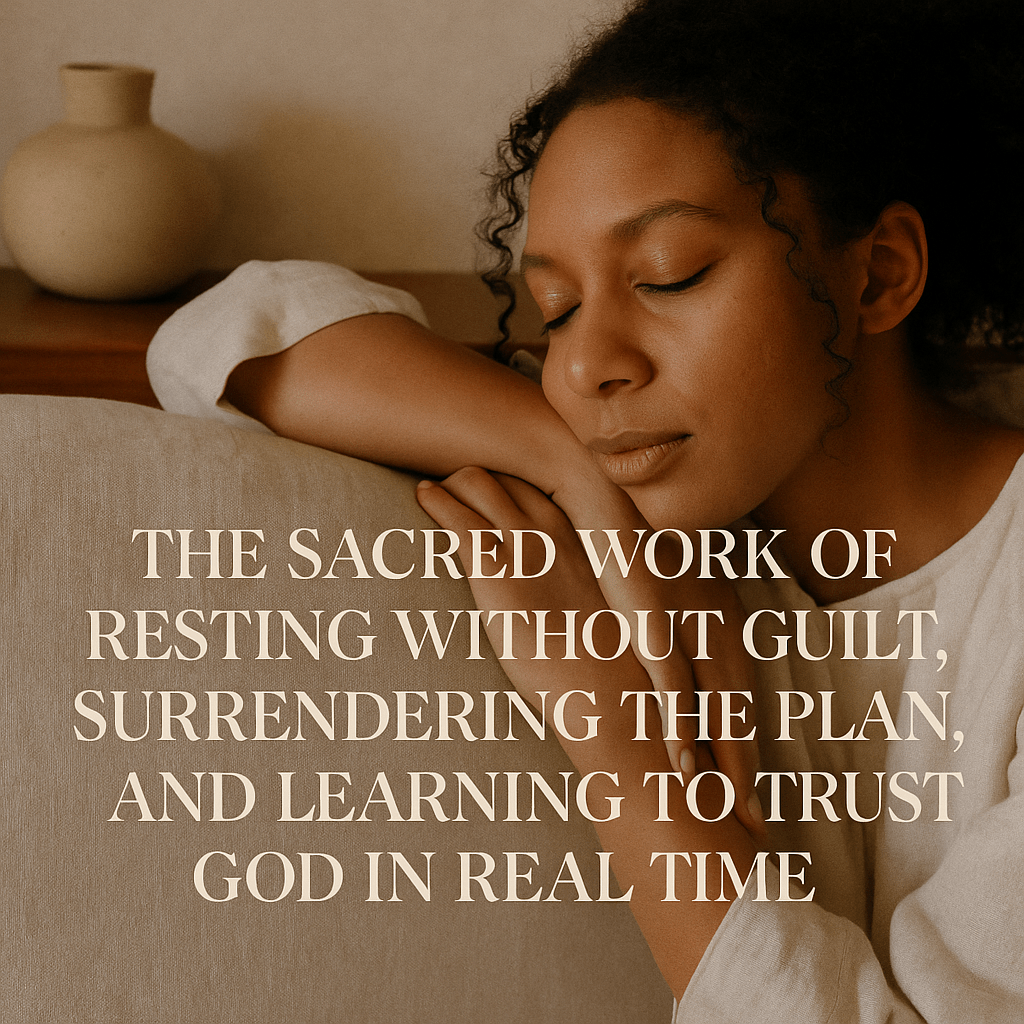
  • The Sacred Work of Resting Without Guilt, Surrendering the Plan, and Learning to Trust God in Real Time

    The Sacred Work of Resting Without Guilt, Surrendering the Plan, and Learning to Trust God in Real Time

    There was a moment—recently, actually—when I sat in my room surrounded by half-finished ideas, unopened emails, and a heart that felt too tired to keep performing.

    I looked around and realized…

    I had no plan. No next step. No fire left to fake it.

    And for the first time in a long time, I didn’t want to push through it.

    I just wanted to rest.

    But that scared me.

    Because rest, for women like us—women who have survived off strength—can feel like failure.

    Like letting the world move without you.

    Like being lazy. Or falling behind.

    But what if I told you that rest isn’t weakness?

    That surrender doesn’t mean defeat—

    It means devotion.

    It means trust.

    Nobody teaches you how to trust God in real time.

    Not when everything’s going right.

    I mean when the plan falls apart.

    When the vision board starts to feel like a lie.

    When you’re in the hallway between what you prayed for and what hasn’t shown up yet.

    It’s one thing to trust God with hindsight.

    But to trust Him right here—in the pause, in the unraveling, in the silence?

    That’s sacred work.

    Resting without guilt requires reparenting yourself.

    I had to sit with the part of me that only felt valuable when I was producing something.

    The part that confused hustle for healing.

    The part that believed if I wasn’t pushing, striving, creating—I wasn’t enough.

    That voice? It wasn’t mine.

    It was inherited.

    It was survival.

    It was my old blueprint.

    But I’m building a new one now.

    One where rest is not earned—it’s honored.

    One where I don’t need a reason to pause.

    One where I can lay my plans down without thinking I’m letting God down too.

    This season has taught me something I’ll never forget:

    When you stop trying to control every outcome,

    When you stop begging for clarity before you take a step,

    When you stop asking “God, just give me the full picture” before you move…

    You finally start to live from trust instead of fear.

    Not because you know what’s coming.

    But because you know Who is with you in the unknown.

    Here’s how I’m learning to rest, surrender, and trust right now:

    1. I no longer ask for signs. I ask for stillness.

    Because sometimes the sign is in the pause.

    Sometimes God is saying, “You don’t need confirmation. You just need to breathe.”

    2. I give myself permission to not be “on.”

    Not every season is meant for output.

    Some seasons are meant to restore what burnout tried to steal.

    3. I lay the plan down every morning.

    Literally. I write my to-do list and then I whisper:

    “But God, if You need to interrupt this—I trust You.”

    That’s not easy. But it’s freedom.

    4. I remember that provision is not limited by my performance.

    Even when I rest, He works.

    Even when I pause, I’m still held.

    Even when I don’t feel productive, I am still protected.

    So if you’re tired—really tired—this post is your permission slip.

    To stop forcing.

    To stop pretending.

    To stop proving.

    Lay it all down.

    The timeline.

    The expectation.

    The weight.

    And pick up something lighter:

    Peace.

    Presence.

    God’s promise.

    You don’t need to have it all figured out.

    You just need to trust that you’re not being forgotten in the stillness.

    This is sacred.

    This is holy.

    This… is real-time trust.

    And if all you can do today is breathe, whisper a prayer, and believe that rest is also part of the work—

    then baby, you are right on time.

  • Protect Your Softness, But Never Mistake It for Weakness

    Protect Your Softness, But Never Mistake It for Weakness

    There’s a misconception that being soft means being weak. That a woman who embraces her femininity, her emotions, and her tenderness is somehow naive or fragile.

    But real softness? Is strength in disguise.

    It takes power to remain soft in a world that tries to harden you. It takes discipline to choose grace when you could retaliate. It takes wisdom to know when to be gentle and when to be firm.

    But let’s be clear—being soft does not mean being a pushover.

    Softness With Boundaries is Unstoppable

    Too many women either suppress their softness in an attempt to be “strong” or let people take advantage of it by lacking boundaries.

    True feminine power lies in balance. It’s about knowing:

    • Your kindness is a choice, not an obligation.

    • Your patience has limits, and those limits must be respected.

    • Your emotions are valuable, but they do not control you.

    • Your ability to love deeply does not mean you tolerate disrespect.

    Softness without strength invites mistreatment. Strength without softness breeds isolation. The most powerful women master both.

    How to Protect Your Softness Without Losing Your Strength

    1. Trust Your Intuition – Being soft doesn’t mean ignoring red flags. Honor your inner knowing and act accordingly.

    2. Set Boundaries Without Guilt – You can be warm and loving while still saying, “This does not work for me.”

    3. Recognize Who Deserves Your Energy – Not everyone is worthy of your gentleness. Save it for those who appreciate it.

    4. Stand Firm When Necessary – Your softness is not an excuse for anyone to underestimate you. If they do, let them be surprised when you remind them otherwise.

    You Can Be Both—And That’s the Secret

    The world tells women they must choose: Be soft or be strong. Be kind or be firm. Be loving or be powerful.

    But the truth? You were never meant to choose. You were meant to be both.

    Soft, but untouchable.

    Loving, but not naive.

    Open-hearted, but with an iron backbone.

    Because a woman who can master both softness and strength? She is unstoppable.

  • How to Cultivate Soft Power in a Hard World

    How to Cultivate Soft Power in a Hard World

    Because Strength Doesn’t Have to Be Loud

    In a world that often celebrates loudness and dominance, embracing soft power can feel counterintuitive. But it’s precisely this quieter, more intentional strength that has the power to inspire, influence, and transform lives.

    Soft power isn’t about being passive. It’s about moving with grace, setting boundaries with confidence, and trusting your presence is enough. In this post, I’ll share practical ways to cultivate soft power so you can navigate life with quiet strength and unshakable self-worth.

    1️⃣ Understand the Essence of Soft Power

    Soft power isn’t about shrinking or staying silent. It’s about choosing your energy wisely and being intentional with your words, actions, and presence.

    Think of soft power as the ability to influence and inspire without force. It’s rooted in self-trust, emotional intelligence, and the knowledge that true strength doesn’t have to demand attention—it naturally commands it.

    2️⃣ Master the Art of Stillness

    In a noisy world, stillness is a superpower. Instead of reacting to every situation, cultivate the habit of pausing, observing, and responding with intention.

    Why It Matters: Stillness allows you to process your emotions and think clearly before taking action.

    How to Practice: The next time you’re faced with a stressful situation, take a deep breath, pause, and ask yourself: “What outcome aligns with my values?”

    3️⃣ Speak Less, Mean More

    One of the hallmarks of soft power is the ability to communicate effectively without saying too much.

    Why It Matters: Words carry weight when they’re used intentionally.

    How to Practice: Before speaking, ask yourself: “Is this true? Is it kind? Is it necessary?” This approach ensures your words are purposeful and impactful.

    4️⃣ Set Boundaries with Grace

    Soft power doesn’t mean being a pushover. It means knowing your worth and being confident in protecting your peace.

    Why It Matters: Boundaries create space for respect and mutual understanding.

    How to Practice: Use phrases like:

    • “I appreciate you asking, but I need to focus on myself right now.”

    • “This doesn’t align with what’s best for me, but thank you for thinking of me.”

    5️⃣ Trust in Divine Timing

    Soft power is deeply rooted in faith—faith in yourself, your intuition, and the timing of life.

    Why It Matters: When you trust that what’s meant for you will come, you stop chasing and start attracting.

    How to Practice: Shift your mindset from scarcity (“I have to act now or I’ll miss my chance”) to abundance (“What’s meant for me won’t pass me by”).

    6️⃣ Embody Confidence, Not Force

    Confidence is magnetic when it’s quiet and secure. Soft power allows you to exude self-assurance without forcing it.

    Why It Matters: Confidence rooted in self-worth doesn’t need external validation.

    How to Practice: Focus on how you feel, not how you’re perceived. Affirm to yourself: “I am enough as I am.”

    Final Reflection

    Cultivating soft power is about showing up for yourself in a way that feels authentic, grounded, and aligned with your values. It’s about trusting your presence, energy, and ability to navigate life with grace and intention.

    So, here’s my challenge for you:

    💬 What’s one way you can start embracing soft power in your life today?

    Let me know your thoughts in the comments—I’d love to hear your story.