Category: Soft Power

  • You’re Not Too Much—They Were Just Too Small

    You’re Not Too Much—They Were Just Too Small

    There’s a lie that so many of us, especially women, have been fed since the beginning:

    That we have to shrink in order to be loved.

    That our softness is a burden.

    That our strength makes us intimidating.

    That our emotions are too much.

    And what happens when you hear that lie enough times?

    You start trying to edit yourself.

    You overthink every word, every feeling, every truth your body wants to speak.

    You start shrinking in places where you were born to rise.

    But let me tell you something—and I want you to read this slow:

    You were never too much.

    You were never too sensitive.

    You were never too emotional, too bold, too loud, too honest.

    They were just too small to hold the fullness of you.

    You weren’t asking for too much—you were just asking the wrong people.

    The truth is, being deeply connected to yourself and your truth is a gift. Not everyone will know what to do with that. And that’s not your burden to carry. That’s their limitation. Their emotional immaturity. Their discomfort with intimacy. Their unhealed parts reacting to your wholeness. And you do not have to apologize for that.

    In fact, one of the softest, most feminine things you can do is release the need to be understood by everyone.

    Let them misunderstand you. Let them label you. Let them make assumptions.

    You’re not here to be digestible.

    You’re here to be true.

    You don’t have to justify your tears.

    You don’t have to explain why you care so deeply.

    You don’t need to prove your softness isn’t weakness.

    The ones who are meant to see you—will.

    The ones who can hold space for all of you won’t flinch when you bring your full self to the table.

    You don’t need to shrink. You need to stretch.

    You don’t need to quiet down. You need to get louder.

    And not in volume—but in presence. In truth. In power.

    This post isn’t about clapping back.

    It’s about calling yourself forward.

    So let me ask you:

    Where are you still shrinking to fit?

    Who are you editing yourself for?

    What version of you are you finally ready to reclaim?

    This is your permission slip.

    To take up space.

    To show up fully.

    To be both gentle and powerful.

    To be seen, felt, heard—and deeply respected.

    And if someone calls that “too much”?

    Tell them this: “I’m not too much. You’re just not enough for me.”

    Let that be your standard. Let that be your liberation.

    Let this post be your reminder: softness is not weakness, and your truth deserves room. Continue your journey through power, presence, and radical softness at The Soft Power Journal.

  • Softness Is Not the Absence of Strength—It’s the Mastery of It

    Softness Is Not the Absence of Strength—It’s the Mastery of It

    I used to believe that strength had to be hard. That in order to be respected, I had to be loud. That in order to be safe, I had to be guarded. That in order to be taken seriously, I had to carry a sharp tongue and a thick wall.

    But the truth is…

    I was tired.

    There’s a moment in your healing when you realize that what you once called strength was actually survival. That the version of you who fought through the storm was necessary—sacred, even—but not meant to stay. And what comes next is terrifying in its own way: softness.

    Not weakness. Not fragility. Not naïveté.

    Softness.

    The softness that says, I don’t need to prove anything to be powerful.

    The softness that says, I can express without explaining. I can lead without force. I can feel deeply without drowning.

    The softness that knows the difference between being in control and being in alignment.

    Softness is the nervous system healed.

    It’s your inner child safe.

    It’s the grown woman who’s no longer performing strength, but embodying it.

    Because strength that comes from exhaustion will eventually collapse.

    But strength that comes from softness—real, regulated, rooted softness—is unshakeable.

    So no, softness is not the absence of strength.

    It’s the mastery of it.

    It’s what happens when you’ve done the work to feel safe inside your own body again. When you’ve stopped over-explaining, stopped people-pleasing, stopped shrinking or overcompensating. It’s when you’ve learned to move from discernment, not defense.

    Softness isn’t passive. It’s powerful.

    It takes radical trust to walk softly in a loud world.

    It takes discipline to stay gentle when the world told you to harden.

    And it takes courage to reclaim the parts of yourself you once silenced for the sake of survival.

    But here’s the truth:

    Your softness is not a liability. It’s your legacy.

    So if you’re in a season of becoming—of learning to return to softness after survival—I see you.

    And I want you to know: that’s not weakness. That’s your evolution.

  • When Rest Is the Bravest Thing You Can Do

    When Rest Is the Bravest Thing You Can Do

    When Rest Is the Bravest Thing You Can Do

    They told us to be strong. To hustle. To rise above.

    They didn’t teach us how to rest.

    And when they did, rest was framed as a reward—not a right. Something you earned only after you broke your back for it. Only after your energy was wrung dry and your nervous system had nothing left to give.

    But what happens when your body whispers enough long before the world agrees?

    This year taught me how brave rest really is.

    It’s brave to pause when everyone else keeps going.

    It’s brave to say no without explanation.

    It’s brave to soften, especially when you’ve been taught that softness is weakness.

    I used to feel guilty for slowing down. I’d internalized the belief that burnout was a badge of honor. That pushing through made me powerful. But all it ever did was make me resentful, tired, disconnected—from myself, from others, from my purpose.

    And if I’m honest, that guilt didn’t come from nowhere. It came from generations before me who didn’t have the luxury to slow down. Women who carried the weight of entire families, entire systems, without ever being asked how they were doing.

    So when I rest now, I don’t just rest for me. I rest for them, too.

    Because rest is resistance.

    Rest is reclamation.

    Rest is remembering that I am not a machine, I am a woman.

    And this isn’t about choosing between purpose or peace. It’s about realizing that you need peace to walk in your purpose. That clarity doesn’t come from overdrive—it comes from stillness.

    So if you’re in a season where your body is asking you to slow down… listen.

    That is the work.

    You are still worthy even when you’re not producing.

    You are still powerful even when you pause.

    You are still you, even when you rest.

    And sometimes, rest is the bravest thing you can do.

    📌 Let this be your permission slip.

    If this resonated, explore more reflections and resources throughout The Soft Power Journal. This space was created for women like you—women who are learning to reclaim softness, regulate their nervous systems, and rewrite their stories without shame.

    You don’t have to do it alone.

    You just have to start where you are.

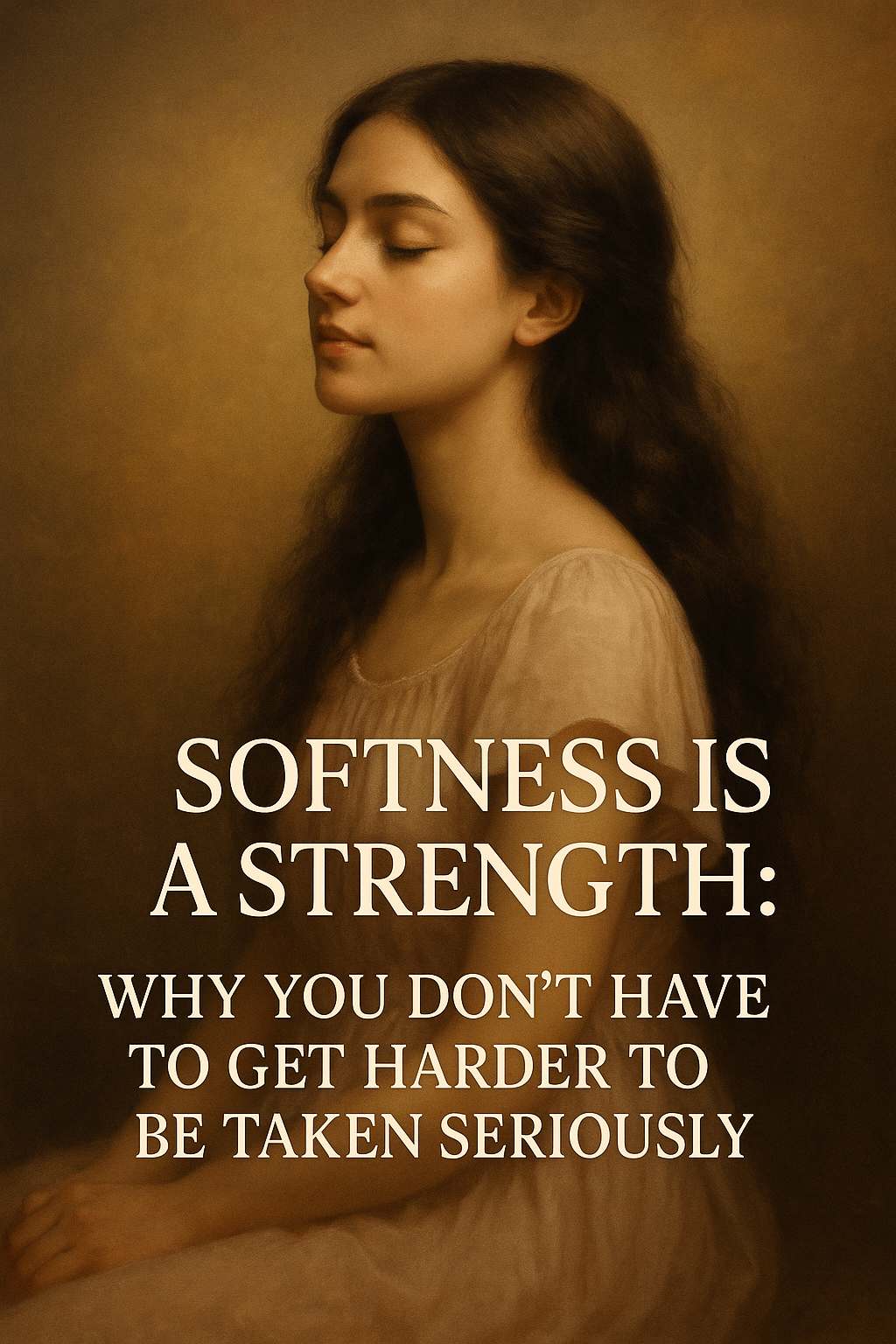
  • Softness is a Strength: Why You Don’t Have to Get Harder to Be Taken Seriously

    Softness is a Strength: Why You Don’t Have to Get Harder to Be Taken Seriously

    I used to believe that strength had to look like sharp edges. Like staying unbothered, never crying, walking through the world untouched, unaffected, and completely self-sufficient. I thought softness was a liability—something that would make people question my authority or overlook my worth.

    But here’s the truth no one told me: Softness is not the opposite of strength. It’s the birthplace of it.

    Softness is what lets you feel. Stay grounded. Stay human. It’s what allows you to stay connected to your intuition in a world that profits off your disconnection. It’s what keeps you tender in moments when life tries to turn you cold.

    I learned this the hard way. When I started showing up softer—more present, more in tune, more vulnerable—some people did fall away. But the right ones? The ones who could hold my full humanity? They leaned in. They saw me more clearly.

    We’re taught to lead like men to be respected. To speak with edge. To hustle harder. To earn our rest. But the women I admire most don’t lead with force—they lead with presence. With inner steadiness. With grace that refuses to shrink, even when it’s misunderstood.

    Here’s why you don’t have to harden to be taken seriously:

    Because power rooted in love is louder than power rooted in fear.

    Because boundaries set with clarity carry more weight than defenses built from trauma.

    Because when you trust your own voice, you don’t need to mimic anyone else’s tone.

    Because emotional regulation isn’t weakness—it’s wisdom.

    And here’s what softness can actually look like:

    Saying no without needing to explain yourself.

    Letting yourself cry when your heart is heavy—without shame.

    Speaking from your center, not from your armor.

    Choosing peace over performance.

    Walking away from spaces that only value you when you’re performing strength.

    Softness doesn’t mean shrinking. It doesn’t mean passivity. And it definitely doesn’t mean weakness.

    It means standing in your power while still choosing tenderness.

    It means protecting your peace without becoming hard to love.

    It means honoring your emotions as sacred messengers—not things to silence.

    This is your reminder:

    You don’t have to become harder to be respected.

    You just have to become more you.

    Let softness be your rebellion.

    Let it be the new standard for strength.

  • Dear Former Me:

    Dear Former Me:

    This isn’t a letter to my past self, but a poem that grew from the same soil. It’s called Behind the Smile…

    Behind the smile is a girl who’s tired of waiting for people to see her fire.

    She laughs loud but it’s a shield,

    a soft heart wrapped in the battlefield.

    Behind the smile is the weight of “I’m fine”.

    A thousand no’s dressed up like a sign.

    It’s cracked ribs from holding it in.

    The art of breaking without making a scene.

    She beams like the sun- on purpose not ease

    ‘cause no one asked how she weathered the freeze.

    She shows up radiant, dressed in gold, but no one asked what that brightness holds

    Behind the smile is grief that lingers.

    Dreams slipping through trembling fingers.

    The girl who claps for everyone’s win, but wonders when hers will begin.

    It’s the mask she wears to keep peace alive,

    the ache she silences just to survive.

    It’s knowing her worth in a world that forgot

    and loving herself whether seen or not.

    So next time you see her and she grins wide,

    don’t just compliment the light in her eyes.

    Ask her how long she’s been standing alone,

    holding her softness like a cornerstone because behind the smile,

    there’s strength you’ll never measure

    a soul stitch together

    by pain

    and still by pleasure.

    Evelyn Michelle

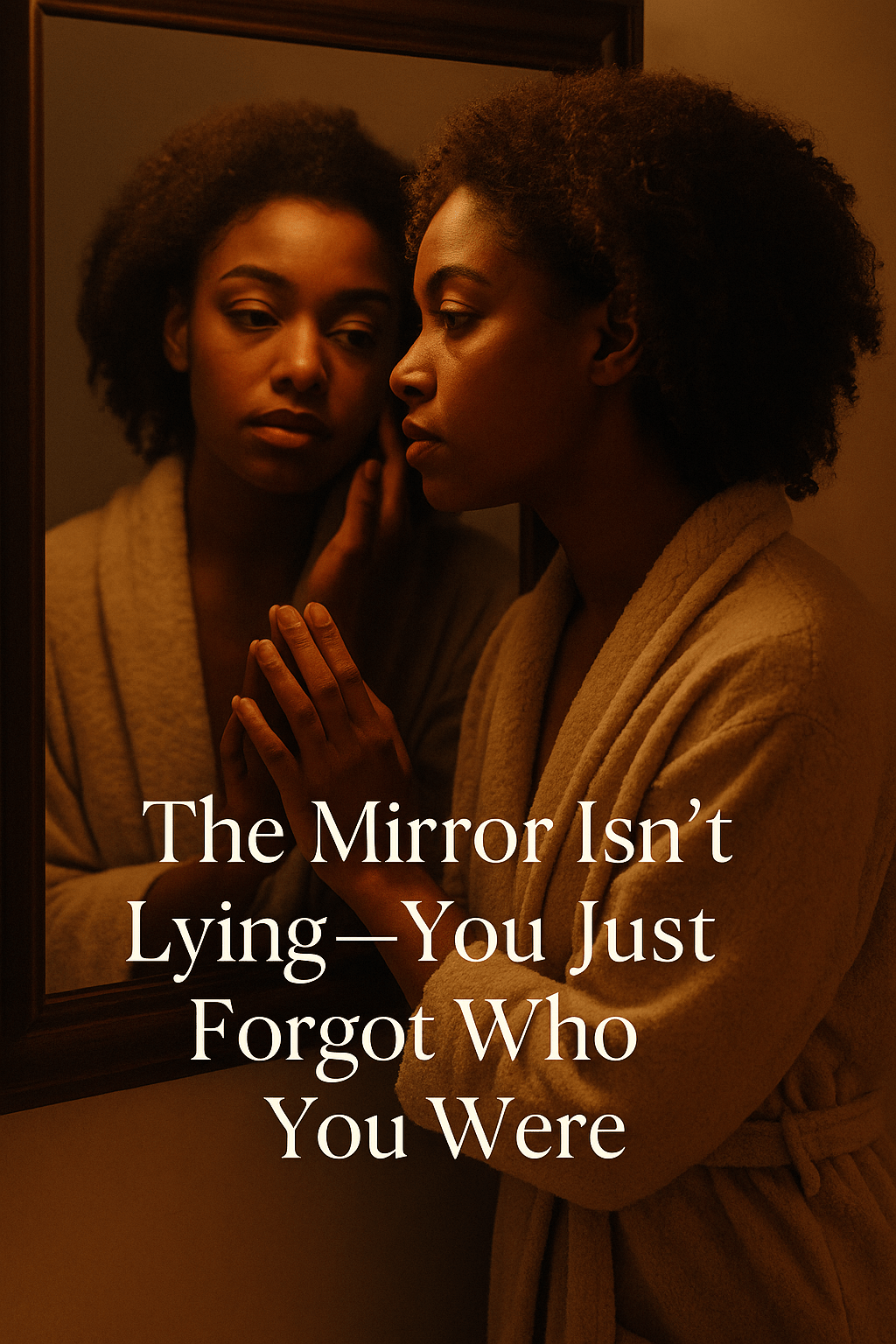
  • The Mirror Isn’t Lying—You Just Forgot Who You Were

    The Mirror Isn’t Lying—You Just Forgot Who You Were

    The other day, I looked in the mirror and froze.

    Not because I didn’t like what I saw—

    but because I didn’t recognize her.

    The eyes were familiar. The skin was soft. The expression was calm.

    But something about her felt… distant. Muted. Unnamed.

    And then it hit me:

    I’ve been so busy surviving, evolving, adapting, performing… I forgot how to just be.

    I forgot who I was underneath the layers.

    But the mirror?

    She wasn’t lying.

    She was simply reflecting the truth I’d been avoiding:

    I lost touch with the version of me I never should’ve left behind.

    We don’t just lose ourselves in crisis.

    We lose ourselves in expectations.

    In performance.

    In being what everyone else needed before we ever asked ourselves what we needed.

    We disappear behind the “good girl.”

    The reliable friend. The strong one. The healer. The doer. The one who doesn’t need anything.

    Until one day, we stop asking what we want altogether.

    We’re just… functioning.

    Smiling on cue. Showing up out of habit.

    But disconnected from our joy, our depth, our essence.

    You don’t need to reinvent yourself. You need to return to yourself.

    Because she’s still in there.

    The girl who loved loudly.

    Who didn’t apologize for her softness.

    Who danced without needing a reason.

    Who believed her voice mattered before the world tried to silence her.

    You didn’t lose her.

    You just stopped listening.

    But the mirror? She remembers.

    And she’s waiting for you to remember, too.

    Here’s how I started returning to the version of me I forgot:

    1. I made a “Remember Me” list.

    I wrote down what I used to love, before I tried to make everyone else comfortable.

    Books I devoured. Music I cried to. The way I dressed when I wasn’t dressing for approval.

    It brought her back to me.

    2. I stood in the mirror and said, “I miss you.”

    I let the grief surface.

    Because sometimes remembering who you were means mourning who you had to become just to survive.

    3. I stopped waiting to feel ready to be her again.

    You don’t have to “go back.”

    You just have to say yes to who you’ve always been.

    Even if it’s one gentle layer at a time.

    The mirror isn’t here to expose you. It’s here to bring you home.

    So let yourself come back.

    To the softness.

    To the laughter.

    To the clarity.

    To the girl who still lives under the ache.

    She didn’t leave.

    She’s just been waiting for you to stop performing and start remembering.

    You are not lost. You are layered.

    And every layer you peel back brings you closer to the girl who never stopped whispering:

    I’m still in here.

  • The Truth Is, I Wasn’t Lazy—My Nervous System Was Tired

    The Truth Is, I Wasn’t Lazy—My Nervous System Was Tired

    For the longest time, I thought I was the problem.

    The version of me who couldn’t get out of bed some days.

    The one who started a project and abandoned it halfway through.

    The woman who kept telling herself, “You have so much potential, why can’t you just do the thing?

    I wasn’t lazy.

    I was tired.

    But not just physically tired—my nervous system was tired.

    And I didn’t know how to name that until I started healing for real.

    Nobody talks about what happens after survival mode ends.

    When your body finally has permission to pause.

    When the adrenaline fades.

    When the constant urgency quiets—

    And suddenly, you don’t know how to function without chaos driving the wheel.

    That’s not laziness.

    That’s your nervous system asking: “Can I finally rest now?

    I’ve learned that “not doing enough” is often just your body trying to protect you.

    And for women who have carried generations of pressure, perfectionism, and productivity—we don’t always know how to just be.

    We shame our slowness.

    We label our fatigue as failure.

    We call ourselves lazy when really…

    we’re just trying to feel safe for the first time.

    Here’s what nervous system exhaustion can look like (that you might mistake for laziness):

    Chronic procrastination (your brain is overloaded, not unmotivated)

    Forgetfulness or zoning out (that’s dissociation, not flakiness)

    Starting something, then freezing (a trauma response, not inconsistency)

    Struggling to complete simple tasks (because your energy is in survival, not thriving)

    Feeling “numb” when you used to be excited (that’s emotional depletion, not apathy)

    So how do we start honoring our nervous systems instead of shaming them?

    1. Replace judgment with curiosity.

    Instead of “What’s wrong with me?” try:

    What might my body be trying to say?

    2. Make rest part of the healing—not the reward.

    You don’t have to earn it. You need it.

    Daily. Not just after burnout.

    3. Start with micro moves.

    When you feel frozen, try the 2-minute rule.

    Two minutes of movement.

    Two minutes of breath.

    Two minutes of showing up for yourself—gently.

    4. Learn your own regulation tools.

    For some, that’s walking.

    For others, journaling. Or humming. Or crying. Or breathwork.

    Your body has wisdom. Let her lead.

    This is your reminder: You are not broken. You’re just healing.

    Healing is a full-body thing.

    It affects your energy. Your emotions. Your motivation.

    And yes, your capacity.

    You’re not behind.

    You’re not lazy.

    You’re learning how to feel safe again—without chaos, without pressure, without constantly proving your worth.

    So next time your body asks to slow down…

    Don’t call it lazy.

    Call it sacred.

    Call it nervous system wisdom.

  • Surrendering the Plan: Learning to Trust God in Real Time

    Surrendering the Plan: Learning to Trust God in Real Time

    Let me be honest—

    I love a good plan. A five-step strategy. A mapped-out vision with bullet points and backup routes.

    I love knowing what’s coming.

    It makes me feel safe.

    But lately?

    God hasn’t been giving me a plan.

    He’s been giving me moments.

    Moments that stretch me, quiet me, reroute me, and ask me to trust without clarity.

    And trusting God in real time?

    It’s one of the hardest things I’ve ever had to learn.

    Real-time trust doesn’t come with a roadmap.

    It comes with a whisper: “Are you willing to move before it all makes sense?

    It comes with blank pages, canceled plans, and doors you thought were yours slamming shut.

    It comes with you looking around, asking:

    God, I thought I was ready. Why does this feel like falling apart instead of falling into place?

    But what I’m learning is this:

    Trust isn’t built when everything is going right. It’s built in the silence between what you prayed for and what hasn’t shown up yet.

    I had to learn that surrender doesn’t mean giving up—it means letting go of my way.

    Letting go of the fantasy timeline.

    Letting go of the need to control the outcome.

    Letting go of my obsession with being “prepared enough.”

    Because sometimes, God doesn’t want your preparation—He wants your presence.

    He wants your obedience in the uncertainty.

    He wants your yes even when you’re trembling.

    Here’s what learning to trust God in real time has looked like for me:

    Saying yes to opportunities I didn’t feel fully ready for

    Leaving spaces I prayed to enter, because I no longer belonged there

    Pausing projects that used to bring me life, because they were now draining me

    Listening more, striving less

    Being okay with not being “on fire” but still being faithful

    I’ve had to stop asking for a five-year vision and start asking for today’s instructions.

    If you’re in this space—where nothing looks clear but you know you’re being called to trust—try this:

    1. Start your day with surrender.

    Before the to-do list. Before the scroll.

    Say: “God, interrupt my plan if You need to. I trust You more than I trust my own control.

    2. Accept that clarity often comes in hindsight.

    Don’t wait for the whole staircase—just take the next step you do see.

    3. Stop needing to “feel ready.”

    Obedience won’t always feel comfortable.

    Move anyway. Speak anyway. Begin anyway.

    4. Pay attention to peace.

    God’s plan often sounds like stillness, not pressure.

    If the plan is stressing your soul, it might be time to let it go.

    You don’t need to figure everything out. You just need to stay open.

    Let this be your reminder:

    You’re not falling behind when the plan shifts—you’re being aligned in real time.

    What feels like delay might actually be divine protection.

    What feels like loss might actually be redirection.

    And what looks like confusion might actually be the start of your clearest season yet.

    If you’re learning to walk with God moment by moment,

    If you’re trying to surrender the plan without collapsing in fear,

    If you’re trusting without the full picture—

    You’re doing sacred work.

    You’re walking by faith.

    And that… is more than enough.

  • Dear Former Me — The Version Who Thought She Had to Earn Her Worth

    Dear Former Me — The Version Who Thought She Had to Earn Her Worth

    I remember how you used to stare at your phone, wondering if silence meant rejection.

    How you’d spiral when someone withdrew their energy, blaming yourself for their confusion.

    How you’d rehearse every boundary in your head, afraid that speaking your needs would make you too much to stay.

    You didn’t want to be a burden.

    You wanted to be the peace someone came home to.

    Even if it cost you your own.

    I remember the night you cried after recording—how your voice cracked trying to sound strong.

    How you gave grace to someone who never apologized, hoping quiet kindness would invite accountability.

    How you kept showing up, even when you felt invisible in return.

    You kept shrinking to fit into spaces that were never built for your power.

    And deep down, you believed if you loved hard enough, they’d see you clearly.

    But you’re not invisible anymore.

    You’ve stopped begging for clarity from people who only offer confusion.

    You’ve stopped mistaking kindness for consistency.

    You’ve stopped abandoning yourself just to feel chosen for a moment.

    You are not hard to love.

    You just outgrew the people who only knew how to hold you halfway.

    And now?

    Now, your peace is louder than your performance.

    Your silence isn’t punishment—it’s protection.

    And your presence is the reward—not something you ever had to earn.

    You made it, baby.

    You walked yourself home.

    Not to perfection—but to your power.

    And whatever comes next?

    It’s not gonna require shrinking, guessing, or over-explaining.

    It’s gonna meet you in your fullness.

    I’m proud of you. I trust you. I’m not letting go of you again.

    I love you so much.

    Love, Evelyn

  • Signed: You’re Ready to Be Seen in a New Way

    Signed: You’re Ready to Be Seen in a New Way

    There comes a moment—quiet, sacred, maybe even scary—when you realize:

    You’re not who you used to be anymore.

    You’ve outgrown the mask.

    You’ve softened the armor.

    You’ve grieved the version of you that once needed to be everything for everyone.

    And now? You’re being invited to show up differently.

    Not louder. Not smaller. Not more polished.

    But truer.

    This is your soul’s signature on the dotted line that says:

    I’m ready to be seen. For real this time.

    But being seen… that’s not always easy.

    It sounds beautiful, but it requires layers to be shed.

    Old roles. Old stories. Old coping mechanisms that once kept you safe.

    Because visibility isn’t just about exposure—it’s about vulnerability.

    It’s about letting people meet the version of you that doesn’t need to be understood to feel valid.

    And that kind of presence?

    It changes things. It changes you.

    Here’s what being seen in a new way might look like:

    Saying “no” and not explaining it Taking up space with your softness, not in spite of it

    Letting your joy be loud without apologizing

    Wearing what you like, not what’s “on trend”

    Leaving spaces where you’re only tolerated, not honored

    This isn’t about reinventing yourself. It’s about revealing yourself.

    You don’t need a new brand or identity to be worthy of visibility.

    You just need to let the woman you’ve become finally breathe.

    Let her speak in her own voice.

    Let her rest without guilt.

    Let her be bold without performing.

    Because the truth is—you’ve always been her.

    You just stopped hiding.

    Try this: a Visibility Mirror Ritual

    Stand in front of your mirror. Look into your own eyes.

    Say out loud: “I no longer shrink to be understood. I no longer hide to feel safe. I am ready to be seen, and I trust what is revealed will be held.”

    Repeat it every morning for a week. Watch how your energy shifts.

    If you’re scared of being seen—good. That means it’s real. That means it matters.

    But don’t confuse fear with unreadiness.

    You’ve already done the work.

    You’ve already softened.

    You’ve already begun.

    So this post is your sign.

    Signed: You’re ready to be seen in a new way.