
Tag: Divine Feminine

  • Softness Is Not the Absence of Strength—It’s the Mastery of It

    Softness Is Not the Absence of Strength—It’s the Mastery of It

    I used to believe that strength had to be hard. That in order to be respected, I had to be loud. That in order to be safe, I had to be guarded. That in order to be taken seriously, I had to carry a sharp tongue and a thick wall.

    But the truth is…

    I was tired.

    There’s a moment in your healing when you realize that what you once called strength was actually survival. That the version of you who fought through the storm was necessary—sacred, even—but not meant to stay. And what comes next is terrifying in its own way: softness.

    Not weakness. Not fragility. Not naïveté.

    Softness.

    The softness that says, I don’t need to prove anything to be powerful.

    The softness that says, I can express without explaining. I can lead without force. I can feel deeply without drowning.

    The softness that knows the difference between being in control and being in alignment.

    Softness is the nervous system healed.

    It’s your inner child safe.

    It’s the grown woman who’s no longer performing strength, but embodying it.

    Because strength that comes from exhaustion will eventually collapse.

    But strength that comes from softness—real, regulated, rooted softness—is unshakeable.

    So no, softness is not the absence of strength.

    It’s the mastery of it.

    It’s what happens when you’ve done the work to feel safe inside your own body again. When you’ve stopped over-explaining, stopped people-pleasing, stopped shrinking or overcompensating. It’s when you’ve learned to move from discernment, not defense.

    Softness isn’t passive. It’s powerful.

    It takes radical trust to walk softly in a loud world.

    It takes discipline to stay gentle when the world told you to harden.

    And it takes courage to reclaim the parts of yourself you once silenced for the sake of survival.

    But here’s the truth:

    Your softness is not a liability. It’s your legacy.

    So if you’re in a season of becoming—of learning to return to softness after survival—I see you.

    And I want you to know: that’s not weakness. That’s your evolution.
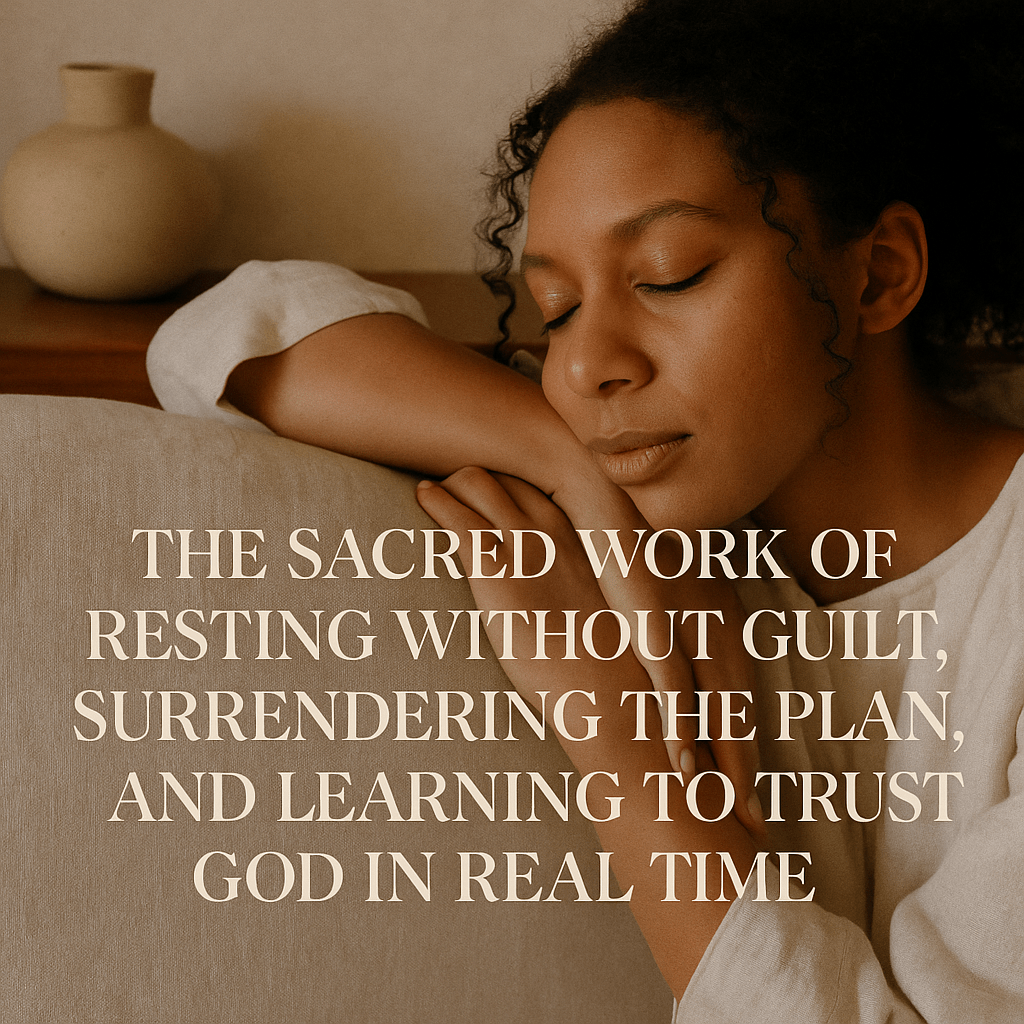
  • The Sacred Work of Resting Without Guilt, Surrendering the Plan, and Learning to Trust God in Real Time

    The Sacred Work of Resting Without Guilt, Surrendering the Plan, and Learning to Trust God in Real Time

    There was a moment—recently, actually—when I sat in my room surrounded by half-finished ideas, unopened emails, and a heart that felt too tired to keep performing.

    I looked around and realized…

    I had no plan. No next step. No fire left to fake it.

    And for the first time in a long time, I didn’t want to push through it.

    I just wanted to rest.

    But that scared me.

    Because rest, for women like us—women who have survived off strength—can feel like failure.

    Like letting the world move without you.

    Like being lazy. Or falling behind.

    But what if I told you that rest isn’t weakness?

    That surrender doesn’t mean defeat—

    It means devotion.

    It means trust.

    Nobody teaches you how to trust God in real time.

    Not when everything’s going right.

    I mean when the plan falls apart.

    When the vision board starts to feel like a lie.

    When you’re in the hallway between what you prayed for and what hasn’t shown up yet.

    It’s one thing to trust God with hindsight.

    But to trust Him right here—in the pause, in the unraveling, in the silence?

    That’s sacred work.

    Resting without guilt requires reparenting yourself.

    I had to sit with the part of me that only felt valuable when I was producing something.

    The part that confused hustle for healing.

    The part that believed if I wasn’t pushing, striving, creating—I wasn’t enough.

    That voice? It wasn’t mine.

    It was inherited.

    It was survival.

    It was my old blueprint.

    But I’m building a new one now.

    One where rest is not earned—it’s honored.

    One where I don’t need a reason to pause.

    One where I can lay my plans down without thinking I’m letting God down too.

    This season has taught me something I’ll never forget:

    When you stop trying to control every outcome,

    When you stop begging for clarity before you take a step,

    When you stop asking “God, just give me the full picture” before you move…

    You finally start to live from trust instead of fear.

    Not because you know what’s coming.

    But because you know Who is with you in the unknown.

    Here’s how I’m learning to rest, surrender, and trust right now:

    1. I no longer ask for signs. I ask for stillness.

    Because sometimes the sign is in the pause.

    Sometimes God is saying, “You don’t need confirmation. You just need to breathe.”

    2. I give myself permission to not be “on.”

    Not every season is meant for output.

    Some seasons are meant to restore what burnout tried to steal.

    3. I lay the plan down every morning.

    Literally. I write my to-do list and then I whisper:

    “But God, if You need to interrupt this—I trust You.”

    That’s not easy. But it’s freedom.

    4. I remember that provision is not limited by my performance.

    Even when I rest, He works.

    Even when I pause, I’m still held.

    Even when I don’t feel productive, I am still protected.

    So if you’re tired—really tired—this post is your permission slip.

    To stop forcing.

    To stop pretending.

    To stop proving.

    Lay it all down.

    The timeline.

    The expectation.

    The weight.

    And pick up something lighter:

    Peace.

    Presence.

    God’s promise.

    You don’t need to have it all figured out.

    You just need to trust that you’re not being forgotten in the stillness.

    This is sacred.

    This is holy.

    This… is real-time trust.

    And if all you can do today is breathe, whisper a prayer, and believe that rest is also part of the work—

    then baby, you are right on time.

  • The Soft Power Strategy of Stillness: Why Not Reacting is Sometimes Your Loudest Move

    The Soft Power Strategy of Stillness: Why Not Reacting is Sometimes Your Loudest Move

    There are moments where silence holds more weight than any speech, more power than any comeback. I didn’t always understand that. I used to think that if I didn’t speak up immediately, I was weak. If I didn’t defend myself, I was letting them win. If I didn’t react, I didn’t care. But I’ve learned that stillness isn’t the absence of power—it’s the mastering of it.

    There was a version of me who couldn’t let anything slide. Who had to explain, defend, fix, over-express, over-explain, overextend. I gave away so much of my energy trying to control how I was perceived, trying to make sure people understood me, trying to avoid being misunderstood. But it cost me peace. And it cost me presence. I was so busy reacting that I couldn’t feel the calm that existed in simply letting things be.

    Stillness is strategy. And for women—especially women who have had to be in survival mode—it’s a reclaiming of something sacred. Because we’ve been taught to always do. Always say something. Always be productive. Always respond. Always fix it. Always manage everyone’s emotions. But what happens when you stop? When you choose to be still, even when it burns?

    I remember a recent situation where someone tried to bait me into a reaction. They wanted to provoke me, twist my words, pull me into chaos. And for a moment, I almost let it work. The old me—the version that needed to prove her worth—was about to come out swinging. But something in me paused. I took a breath. And I said nothing. Not because I was weak. But because I knew I didn’t owe them access to my energy.

    Stillness, in that moment, was strength. It was a declaration. A boundary. A line in the sand that said: I don’t move unless I choose to. I don’t explain myself to people committed to misunderstanding me. I don’t play games in a space I’ve outgrown. I don’t chase clarity where chaos lives.

    The feminine in me knew better. She knew that power doesn’t always come with sound. Sometimes, it comes in silence. Sometimes, the softest thing you can do is also the most radical. To say nothing, to walk away, to remain unmoved—not because you don’t feel anything, but because you finally trust yourself enough to hold what you’re feeling with grace.

    Stillness isn’t passive. It’s powerful. It’s the space where you choose yourself over the need to be right. It’s where you release control, not because you’ve given up, but because you’ve risen above. It’s where you remember that not everything deserves a response, and not everyone deserves a seat at your table.

    It’s in that space—between the trigger and the response—that we reclaim our soft power. That we remind ourselves we are not puppets pulled by strings of emotion or insecurity. We are the string-cutters. The pattern-breakers. The peace-holders. And that means knowing when to speak and when to stay still.

    There will always be noise. Always be drama. Always be people who try to test your growth. But you don’t have to take the bait. You don’t have to prove how far you’ve come. Let your peace do the talking. Let your energy be too expensive for nonsense. Let your stillness become your softest—and strongest—move yet.

    With love-

    Evelyn