Tag: Soft Power

  • The Moment I Realized My Power

    The Moment I Realized My Power

    Because Strength Doesn’t Have to Be Loud

    I used to believe that strength meant being loud. That power meant proving myself, speaking up first, and making sure my presence was felt. I thought that to be strong, I had to be forceful. But there was a moment—a defining one—when I realized that true strength isn’t about how loudly you demand attention.

    It’s about how effortlessly you command it.

    The Moment That Changed Everything

    There was a time when I found myself in a situation where I would have normally reacted—pushed, spoken up, fought to be heard. Instead, I did something different. I leaned back. I stayed still. I allowed the situation to unfold without forcing it.

    And something unexpected happened—everything started working in my favor.

    I wasn’t weak for not reacting. I wasn’t losing control by not proving myself. I was owning my power by choosing stillness over force, grace over reaction, certainty over doubt.

    That was the moment I realized that soft power—quiet, deliberate, deeply-rooted strength—is far more magnetic than trying to prove anything to anyone.

    What Soft Power Truly Means

    Soft power isn’t about being passive. It isn’t about shrinking or letting things happen to you.

    It’s about understanding your worth so deeply that you don’t have to fight for space. It’s about knowing that your presence, energy, and confidence are enough.

    Here’s what I’ve learned:

    • Power isn’t about talking the loudest; it’s about saying the least and still being heard.

    • Confidence isn’t about forcing a response; it’s about knowing you don’t need one.

    • Strength isn’t about control; it’s about trust—trusting yourself, your energy, and the way life unfolds.

    How You Can Embrace Soft Power

    If you’ve ever felt like you had to prove yourself, fight for attention, or make your presence known, I want you to consider this:

    What would happen if you leaned back instead of chasing? If you allowed instead of forcing? If you trusted instead of controlling?

    Here’s how you can start embracing soft power today:

    1. Master the Art of Presence – You don’t need to take up space loudly. Your energy speaks before you even say a word.

    2. Respond, Don’t React – Power is in pausing, observing, and choosing your words carefully.

    3. Trust That What’s Meant for You Will Come – Soft power is deeply rooted in self-trust and divine timing.

    4. Speak Less, Mean More – When you do speak, let your words hold weight, depth, and certainty.

    5. Embody Confidence, Not Force – True confidence isn’t loud; it’s felt. It’s in how you carry yourself, not in how much you say.

    Soft Power Is the Ultimate Strength

    That moment when I chose stillness over reaction changed everything for me. I realized that I didn’t need to prove myself to be powerful—I just needed to embody my worth.

    If this resonates with you, I’d love to know:

    💬 Have you ever experienced a moment where you realized your soft power? Share your thoughts in the comments—I’d love to hear your story.

  • Wholeness Doesn’t Mean You’re Always Okay: Holding Space for the Messy Middle

    Wholeness Doesn’t Mean You’re Always Okay: Holding Space for the Messy Middle

    There’s this quiet pressure in healing culture that whispers, “If you’re doing the work, you shouldn’t still feel like this.”

    But real healing—soul-deep, identity-shifting, root-pulling healing—is not linear, polished, or predictable.

    Wholeness does not mean you’re always okay.

    It means you’re always becoming.

    Some days you’ll feel like the woman you prayed to become. Other days, you’ll feel like the girl who needed rescuing. And both can exist within you. At the same time. Without contradiction. Without shame.

    The Lie of Constant Progress

    We’re taught to measure growth by progress. By movement. By proof. But some of the deepest healing happens in stillness—in the unseen choices, in the quiet no’s, in the tears you don’t post, in the days you show up without makeup or a plan, and still breathe through it.

    There is no perfect version of you waiting at the end of the path. You’re not a problem to be solved. You are a process unfolding.

    This Is What the Messy Middle Looks Like:

    You set boundaries, then second-guess them.

    You choose softness, then feel exposed.

    You reclaim your worth, then catch yourself trying to earn it.

    You feel proud and still deeply tired.

    This is not a setback. It’s the space in between—where you grieve, recalibrate, and re-learn what safety feels like in your body.

    Holding Space for All of You

    You are not meant to heal in a straight line. You are allowed to pause. To feel joy and grief within the same breath. To still long for clarity while honoring how far you’ve come. To admit that even as a whole woman, sometimes you’re just… tired.

    Stop waiting until you feel “more together” to show up for your life. You are already whole. Even when you wobble. Even when you cry. Even when you can’t explain why you feel the way you do.

    This is the brave part of healing no one talks about: allowing the mess and the magic to sit beside each other.

    Let that be enough today.

    If this resonated with you, take a moment to explore more essays inside The Soft Power Journal. Each piece is a quiet return to truth, softness, and soul.

  • Excuses Keep You Stuck: What Are You Still Justifying?

    Excuses Keep You Stuck: What Are You Still Justifying?

    We’ve all done it—defended a choice we outgrew, justified someone’s inconsistency, or explained away our own resistance to growth. But let’s call it what it is: an excuse is still an excuse, no matter how spiritual or intellectual we dress it up to be.

    There’s a difference between honoring your process and avoiding your power. One is rooted in grace. The other in fear.

    Sometimes the most dangerous thing isn’t the habit or the person—it’s the narrative we create around it. The one that lets us stay a little longer in the place we no longer belong. The one that says, “I’m just being patient,” when what we’re really doing is procrastinating on our potential. The one that says, “Maybe they’ll change,” when we know good and well they already showed us who they are.

    The truth? Excuses keep you safe, but they also keep you small. And there comes a point in your journey when protecting your softness requires the kind of structure that no longer allows you to run in circles. When being the woman you prayed to become demands you stop justifying the very things keeping you from her.

    You’re allowed to change your mind. You’re allowed to grow. And you are especially allowed to outgrow the stories that no longer serve you.

    So ask yourself gently—but honestly:

    What are you still explaining away?

    Who are you still making room for that isn’t showing up?

    What are you still calling timing that’s really avoidance?

    You don’t have to shame yourself. You just have to be real enough to call it.

    The moment you stop making excuses is the moment you start making room—for your next level, your next blessing, your next version of you.

    Because liberation doesn’t come with a permission slip. It comes with a decision.

  • Not Everyone Can Walk with You into Your Becoming

    Not Everyone Can Walk with You into Your Becoming

    There comes a point in your journey where your growth becomes too loud to ignore. Where your softness can no longer be mistaken for weakness. Where your soul starts shedding what no longer fits—not because it’s unkind, but because it’s misaligned.

    This is the part they don’t prepare you for.

    Not everyone can walk with you into your becoming.

    Some people are attached to the version of you that never said no. The version that bent over backwards. The one that tolerated crumbs, overlooked patterns, or kept the peace at the expense of her own.

    But becoming is disruptive.

    It reorders the entire room.

    It asks you to choose peace over people-pleasing.

    And in doing so, it naturally reveals who was only comfortable with your silence—not your truth.

    This kind of growth feels like grief. Not because you’re doing something wrong—but because you’re doing something right. You’re honoring the version of you that was always quietly waiting to be chosen by you.

    Letting go doesn’t always come with closure. Sometimes the closure is realizing that you kept the door open for people who were never planning to meet you on the other side.

    And that’s okay.

    Because this chapter isn’t about proving your worth. It’s about protecting it. It’s about becoming the kind of woman who no longer performs for proximity or settles for companionship that costs her clarity. It’s about walking away with your head high and your heart soft—knowing that your becoming will require you to outgrow what once felt like home.

    Let it.

    Let it shape you.

    Let it stretch you.

    Let it show you who’s really capable of loving you through your evolution.

    Because the ones who are meant to walk with you won’t need to be convinced. They’ll rise to meet you. Or they’ll fall away with grace.

    And both are a blessing.

  • You Can’t Shame Me Into Shrinking: The Bold Return to Wholeness

    You Can’t Shame Me Into Shrinking: The Bold Return to Wholeness

    There comes a point in your journey where you stop internalizing the projections of others. You stop negotiating with shame. You stop apologizing for the space you take up, the truth you carry, or the softness you’ve reclaimed.

    Because here’s the truth: people will try to shame you for evolving. They will try to guilt you for growing. They will call your boundaries selfish, your clarity cold, your joy arrogant, and your confidence too much.

    But when you’ve worked for your wholeness—when you’ve bled for your peace, broken generational patterns, and peeled back layers of trauma just to breathe without flinching—why would you ever let someone else’s comfort cost you your healing?

    You don’t owe anyone a diluted version of you just because they haven’t met themselves yet.

    The Lie of Shame and the Cost of Shrinking

    Shame is a tool that keeps us small. It’s weaponized silence. It’s the mechanism of a society that benefits from you staying broken and busy trying to prove your worth. When you shrink, you become easier to manage. When you doubt yourself, you’re easier to control. When you stay quiet, you’re less of a threat.

    But the real threat was never your voice. It was your becoming.

    Let them feel uncomfortable. Let them confront their own limitations when they stand in the presence of someone who has chosen truth, alignment, and softness as her new baseline.

    This isn’t arrogance. This is reclamation.

    You Were Never Too Much—You Were Just Misunderstood

    Your softness isn’t weakness. Your power isn’t a problem. Your presence isn’t a disruption. It’s medicine—for you, and for those with the courage to receive it.

    So if they try to shame you back into silence… keep speaking.

    If they try to guilt you back into pleasing… keep honoring your truth.

    If they try to box you into a version of yourself you’ve outgrown… keep walking.

    You don’t need to dim your light to keep other people comfortable in their shadows.

    You’ve earned your wholeness. Keep it.

    This post is part of the September series on The Soft Power Journal. Keep exploring the truths that help you return to yourself, without apology.

  • You’re Not Too Much—They Were Just Too Small

    You’re Not Too Much—They Were Just Too Small

    There’s a lie that so many of us, especially women, have been fed since the beginning:

    That we have to shrink in order to be loved.

    That our softness is a burden.

    That our strength makes us intimidating.

    That our emotions are too much.

    And what happens when you hear that lie enough times?

    You start trying to edit yourself.

    You overthink every word, every feeling, every truth your body wants to speak.

    You start shrinking in places where you were born to rise.

    But let me tell you something—and I want you to read this slow:

    You were never too much.

    You were never too sensitive.

    You were never too emotional, too bold, too loud, too honest.

    They were just too small to hold the fullness of you.

    You weren’t asking for too much—you were just asking the wrong people.

    The truth is, being deeply connected to yourself and your truth is a gift. Not everyone will know what to do with that. And that’s not your burden to carry. That’s their limitation. Their emotional immaturity. Their discomfort with intimacy. Their unhealed parts reacting to your wholeness. And you do not have to apologize for that.

    In fact, one of the softest, most feminine things you can do is release the need to be understood by everyone.

    Let them misunderstand you. Let them label you. Let them make assumptions.

    You’re not here to be digestible.

    You’re here to be true.

    You don’t have to justify your tears.

    You don’t have to explain why you care so deeply.

    You don’t need to prove your softness isn’t weakness.

    The ones who are meant to see you—will.

    The ones who can hold space for all of you won’t flinch when you bring your full self to the table.

    You don’t need to shrink. You need to stretch.

    You don’t need to quiet down. You need to get louder.

    And not in volume—but in presence. In truth. In power.

    This post isn’t about clapping back.

    It’s about calling yourself forward.

    So let me ask you:

    Where are you still shrinking to fit?

    Who are you editing yourself for?

    What version of you are you finally ready to reclaim?

    This is your permission slip.

    To take up space.

    To show up fully.

    To be both gentle and powerful.

    To be seen, felt, heard—and deeply respected.

    And if someone calls that “too much”?

    Tell them this: “I’m not too much. You’re just not enough for me.”

    Let that be your standard. Let that be your liberation.

    Let this post be your reminder: softness is not weakness, and your truth deserves room. Continue your journey through power, presence, and radical softness at The Soft Power Journal.

  • Softness Is Not the Absence of Strength—It’s the Mastery of It

    Softness Is Not the Absence of Strength—It’s the Mastery of It

    I used to believe that strength had to be hard. That in order to be respected, I had to be loud. That in order to be safe, I had to be guarded. That in order to be taken seriously, I had to carry a sharp tongue and a thick wall.

    But the truth is…

    I was tired.

    There’s a moment in your healing when you realize that what you once called strength was actually survival. That the version of you who fought through the storm was necessary—sacred, even—but not meant to stay. And what comes next is terrifying in its own way: softness.

    Not weakness. Not fragility. Not naïveté.

    Softness.

    The softness that says, I don’t need to prove anything to be powerful.

    The softness that says, I can express without explaining. I can lead without force. I can feel deeply without drowning.

    The softness that knows the difference between being in control and being in alignment.

    Softness is the nervous system healed.

    It’s your inner child safe.

    It’s the grown woman who’s no longer performing strength, but embodying it.

    Because strength that comes from exhaustion will eventually collapse.

    But strength that comes from softness—real, regulated, rooted softness—is unshakeable.

    So no, softness is not the absence of strength.

    It’s the mastery of it.

    It’s what happens when you’ve done the work to feel safe inside your own body again. When you’ve stopped over-explaining, stopped people-pleasing, stopped shrinking or overcompensating. It’s when you’ve learned to move from discernment, not defense.

    Softness isn’t passive. It’s powerful.

    It takes radical trust to walk softly in a loud world.

    It takes discipline to stay gentle when the world told you to harden.

    And it takes courage to reclaim the parts of yourself you once silenced for the sake of survival.

    But here’s the truth:

    Your softness is not a liability. It’s your legacy.

    So if you’re in a season of becoming—of learning to return to softness after survival—I see you.

    And I want you to know: that’s not weakness. That’s your evolution.

  • Surrendering the Plan: Learning to Trust God in Real Time

    Surrendering the Plan: Learning to Trust God in Real Time

    Let me be honest—

    I love a good plan. A five-step strategy. A mapped-out vision with bullet points and backup routes.

    I love knowing what’s coming.

    It makes me feel safe.

    But lately?

    God hasn’t been giving me a plan.

    He’s been giving me moments.

    Moments that stretch me, quiet me, reroute me, and ask me to trust without clarity.

    And trusting God in real time?

    It’s one of the hardest things I’ve ever had to learn.

    Real-time trust doesn’t come with a roadmap.

    It comes with a whisper: “Are you willing to move before it all makes sense?

    It comes with blank pages, canceled plans, and doors you thought were yours slamming shut.

    It comes with you looking around, asking:

    God, I thought I was ready. Why does this feel like falling apart instead of falling into place?

    But what I’m learning is this:

    Trust isn’t built when everything is going right. It’s built in the silence between what you prayed for and what hasn’t shown up yet.

    I had to learn that surrender doesn’t mean giving up—it means letting go of my way.

    Letting go of the fantasy timeline.

    Letting go of the need to control the outcome.

    Letting go of my obsession with being “prepared enough.”

    Because sometimes, God doesn’t want your preparation—He wants your presence.

    He wants your obedience in the uncertainty.

    He wants your yes even when you’re trembling.

    Here’s what learning to trust God in real time has looked like for me:

    Saying yes to opportunities I didn’t feel fully ready for

    Leaving spaces I prayed to enter, because I no longer belonged there

    Pausing projects that used to bring me life, because they were now draining me

    Listening more, striving less

    Being okay with not being “on fire” but still being faithful

    I’ve had to stop asking for a five-year vision and start asking for today’s instructions.

    If you’re in this space—where nothing looks clear but you know you’re being called to trust—try this:

    1. Start your day with surrender.

    Before the to-do list. Before the scroll.

    Say: “God, interrupt my plan if You need to. I trust You more than I trust my own control.

    2. Accept that clarity often comes in hindsight.

    Don’t wait for the whole staircase—just take the next step you do see.

    3. Stop needing to “feel ready.”

    Obedience won’t always feel comfortable.

    Move anyway. Speak anyway. Begin anyway.

    4. Pay attention to peace.

    God’s plan often sounds like stillness, not pressure.

    If the plan is stressing your soul, it might be time to let it go.

    You don’t need to figure everything out. You just need to stay open.

    Let this be your reminder:

    You’re not falling behind when the plan shifts—you’re being aligned in real time.

    What feels like delay might actually be divine protection.

    What feels like loss might actually be redirection.

    And what looks like confusion might actually be the start of your clearest season yet.

    If you’re learning to walk with God moment by moment,

    If you’re trying to surrender the plan without collapsing in fear,

    If you’re trusting without the full picture—

    You’re doing sacred work.

    You’re walking by faith.

    And that… is more than enough.

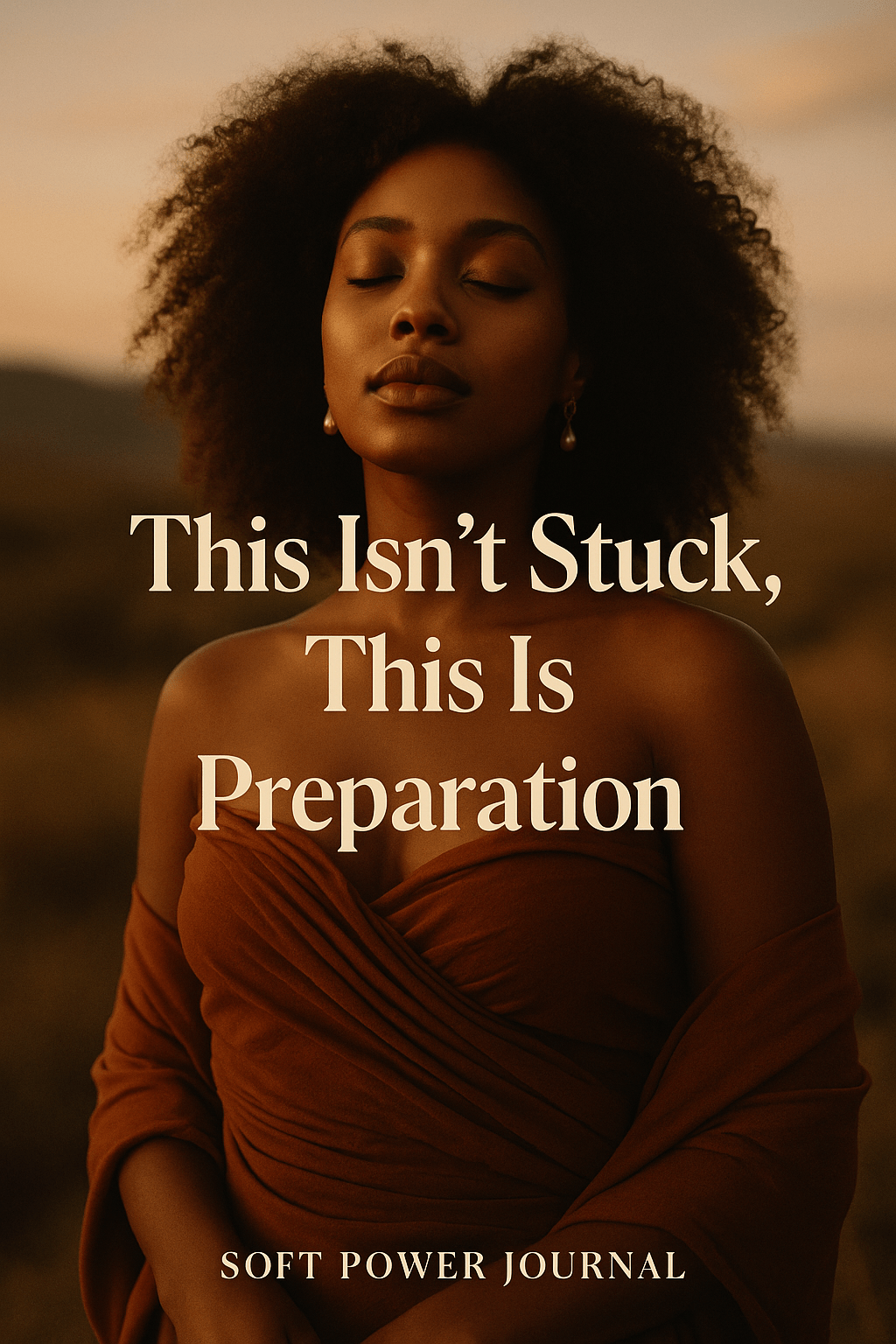
  • This Isn’t Stuck, This is Preparation

    This Isn’t Stuck, This is Preparation

    There’s a moment when the noise dies down.

    The texts slow.

    The plans don’t go through.

    The vision board starts to blur.

    And even though you’re still showing up, still breathing, still doing what you can… it feels like nothing is moving.

    You start wondering if you’re missing something.

    If you lost your touch.

    If God stopped listening.

    But what if… you’re not stuck?

    What if this is holy ground, and you’re standing at the edge of a becoming too sacred to rush?

    Because here’s what nobody tells you:

    Preparation feels like stillness.

    It feels like quiet days, unseen work, plans that don’t stick, and prayers that echo back with silence.

    It feels like pulling weeds with no sign of blooms.

    And it will feel like stuck—until you realize you’re actually being softened for what’s next.

    I know that space.

    I’ve cried in it. Fought it. Tried to outwork it.

    I’ve sat in rooms where I once felt powerful and wondered why I suddenly felt invisible.

    I’ve looked at other people’s progress and questioned if I took too many detours.

    But eventually I realized:

    Every delay was disguised direction. Every pause was a prayer being answered quietly.

    Because real power?

    It doesn’t always enter loud.

    Sometimes it tiptoes in while you’re wiping your eyes and learning how to be gentle with yourself again.

    Let’s talk about what preparation really looks like:

    It’s the days when nothing makes sense but your intuition won’t let you quit.

    It’s the version of you that doesn’t feel “on,” but somehow still chooses to show up.

    It’s the space between who you’ve been and who you’re becoming—and the ache of no longer fitting into either.

    You’re not being punished.

    You’re being positioned.

    But you’ve gotta stop calling it stuck.

    Because stuck implies lifelessness.

    And sis, you are anything but lifeless.

    You are actively being re-rooted.

    Refined.

    Redirected.

    Even if it doesn’t look like movement, you are becoming.

    Here’s how to hold yourself when it feels like nothing’s happening:

    1. Stop measuring your momentum by what’s visible.

    Growth doesn’t always leave proof. Sometimes the roots are strengthening before the bloom.

    2. Ask: “What is this preparing me for?” instead of “Why is this happening?”

    Shift the narrative. You’re not being blocked, you’re being built.

    3. Create a “preparation altar.”

    Write down what you’re calling in. Add something symbolic—an old photo, a letter, a verse.

    Place it somewhere you’ll see every day. Let it remind you that the pause is sacred.

    4. Breathe. Really breathe.

    When you start to spiral, come back to your body.

    Place your hand on your heart and say: I trust this pause is protecting and preparing me.

    5. Let this version of you be enough.

    Not the “glowed up” one. Not the “ready” one.

    The one that’s in-between. The one learning how to hold faith without a finish line.

    If this season is quiet… you’re not broken. You’re being spoken to differently.

    So maybe it’s not time to force a breakthrough.

    Maybe it’s time to receive what only silence can offer.

    You don’t need to have all the answers.

    You don’t need to be on fire to be walking in purpose.

    And you don’t need to rush something that’s already yours.

    This isn’t stuck.

    This is where your wings are being stretched.

    This is where your prayers are gaining roots.

    This is where power is being woven into your stillness.

    This… is preparation.

  • Your Presence is the Power

    Your Presence is the Power

    The most magnetic women don’t force attention. They don’t chase. They don’t beg.

    They simply exist in their power, and people feel it.

    Your presence alone should shift a room—not because you’re loud, not because you’re trying to be seen, but because you are deeply rooted in yourself. Your energy, your confidence, your very essence speaks before you ever say a word.

    But here’s the thing: If you don’t own your presence, no one else will.

    Owning Your Presence Starts With You

    Magnetic energy isn’t about arrogance. It’s about certainty. It’s about knowing exactly who you are and carrying yourself with an unshakable sense of self-worth.

    Here’s how you cultivate that level of presence:

    1. Know Who You Are – Confidence isn’t about proving anything; it’s about being so grounded in yourself that validation becomes irrelevant.

    2. Master the Art of Stillness – You don’t need to constantly be doing or saying something to be powerful. The most influential people can command a room simply by being in it.

    3. Speak with Intention – The most powerful people aren’t the ones who talk the most, but the ones who speak with purpose. Don’t waste words—make them count.

    4. Walk Like You Belong – Even if you feel out of place, move like you don’t. Your energy will make space for you.

    5. Be Selective with Your Energy – Not everyone deserves access to you. Your presence is valuable—treat it that way.

    The Silent Power of an Unbothered Woman

    When a woman truly owns her presence, she doesn’t seek validation. She doesn’t shrink. She doesn’t overexplain.

    She just is.

    And that alone? Is enough to make the right people notice.

    When you stop trying to be seen and start embodying your power, people will feel the difference. They won’t be able to ignore you.

    Because presence is energy. Presence is power.

    And when you truly step into it, the world will adjust to you.